
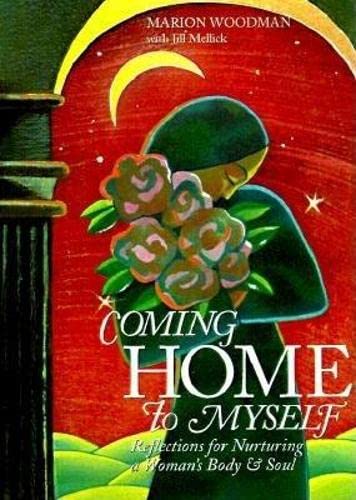
Coming Home to Myself: Reflections for Nurturing a Woman's Body and Soul (Prose Poetry and Meditations, Affirmations)
Goodman, Marion
ISBN 10: 1573241008 ISBN 13: 9781573241007
Published by Conari Press, 1998
New
Hardcover
From
Toscana Books, AUSTIN, TX, U.S.A.
Seller rating 5 out of 5 stars

AbeBooks Seller since November 7, 2023
This specific item is no longer available.
About this Item
Description:
Excellent Condition.Excels in customer satisfaction, prompt replies, and quality checks. Seller Inventory # Scanned1573241008
Synopsis:
Including 365 meditations for body and soul, this volume is designed to appeal to those readers who are looking for a deeper approach to daily inner work. It is organized into themes such as: perfectionism, conscious femininity, body, and finding one's own voice.
Excerpt. © Reprinted by permission. All rights reserved.:
Coming Home to Myself
Daily Reflections for a Woman's Body and Soul
By Marion Woodman, Jill MellickRed Wheel/Weiser, LLC
Copyright © 1998 Marion Woodman and Jill Mellick
All rights reserved.
ISBN: 978-1-57324-100-7All rights reserved.
Contents
| 1. New Resonances—MARION WOODMAN | |
| 2. Women's Lives, Women's Stories— JILL MELLICK | |
| 3. Learning to Trust & Receive | |
| 4. My Body | |
| 5. Beyond Addiction & Possession | |
| 6. Beyond Perfection & Duty | |
| 7. Reclaiming My Own Energies | |
| 8. Unmasking Myself | |
| 9. Finding My Own Voice | |
| 10. Leaving My Father's House | |
| 11. Active Surrender | |
| 12. The Black Madonna: Embodied Feminine | |
| 13. Sophia: Feminine Wisdom | |
| 14. The Crone | |
| 15. Conscious Femininity | |
| 16. Integrating Masculine Energy | |
| 17. The Inner Marriage | |
| 18. Creativity | |
| 19. Dream Wisdom | |
| 20. Holding Conflict Creatively | |
| 21. Finding Meaning in Darkness | |
| 22. Living with Paradox | |
| 23. Delighting in Play & Imagination | |
| 24. Beyond Power & Patriarchy | |
| 25. Practicing Presence | |
| 26. Trusting Deeper Processes | |
| 27. Body-Soul Resonance | |
| 28. Rites of Passage | |
| 29. The Shadow | |
| 30. Coming to Love | |
| 31. Trusting the Mystery | |
| 32. Listening to My Soul | |
| 33. Timely Sacrifices | |
| 34. Initiation into the Deep Feminine | |
| References |
CHAPTER 1
New Resonances
Marion Woodman
Coming Home to Myself is a surprise child. Born of the insight of my friend andcolleague, Jill Mellick, and my growing curiosity as we revisioned my earlierwork, this little book has happened. Our editor, Mary Jane Ryan, dared theintuitive leap that is re-birthing my work in a distilled form.
I began writing my journal when I was twelve. I am still writing because I amcompelled to find meaning in my experience. In my late teens, I chose tosacrifice my beloved microscope for another kind of poetry, the poetry of word.Still, the scientist in me is always observing with a thinking heart, noting,comparing, articulating.
Twenty years ago, much to my surprise, people were interested in my thesis oneating disorders. Being an addict myself and profoundly introverted, I wasfearful of publication. With the encouragement of Inner City Books, the thesiswas revised and published as The Owl Was a Baker's Daughter.
Addiction to Perfection was my first attempt at writing a book. It came out ofan inner drive to understand the repetitive themes in the dreams of my addictedclients. I put rows of dreams on the floor of my studio, organized andreorganized them by theme. I marveled at the overwhelming power of theunconscious and, at the same time, the intensity of its drive toward healing.
One theme became clear as I began work on The Pregnant Virgin. The way tohealing an addiction lies in finding a connection between body and soul. Soulneeds body as much as body needs soul. Each is out of context without the other,an abandoned fragment of what it is. A great cherishing mother is often the linkthat manifests in dreams. Sometimes she appears as a striding Presence in thesky, sometimes as a bigger-than-life cleaning lady or a down-to-earth crone. Shehas many names: Buffalo Woman, Black Madonna, Isis, Anna, Tara. In the Bible sheis called Wisdom, translated from the Greek word, Sophia. Whatever her temporalform, she is divine; she understands our humanity and her love is fierce enoughto permeate flesh and bone. Her humor rips away veils of illusion. She is thecentral figure in Dancing in the Flames, (Shambhala, 1996) which I co-authoredwith my friend, Elinor Dickson.
As I watched the pregnant virgin coming to consciousness in dreams, I becameincreasingly alarmed by images of ravaged masculinity, masculinity andfemininity both being ravaged by patriarchy. Men and women who have worked hardto find a strong feminine standpoint in Being are now working hard to release amasculinity strong enough to partner the evolving virgin consciousness. Thistheme began by exploring the tragedy of perfection as Keats' "unravished bride"in "Ode on a Grecian Urn." So the process went on through The RavagedBridegroom, Conscious Femininity, and Leaving My Father's House.
One thing has been distilled in my consciousness. By whatever name we call thetwo magnets that create this balance of energies in our bodies and in ourplanet— Masculine/Feminine, Shiva/Shakti, Yang/Yin, Spirit/Soul,Transcendence/Immanence, Doing/Being, we are now responsible for making spacefor the healing of body, soul, and spirit. We are being directed in theevolutionary process by divine guides through our dreams, our symptoms, ourplanet. New values are emerging—feminine values and masculine values that arefree of patriarchal abuse. A totally new harmonic lies ahead in the newmillennium.
I write this down not because I am trying to sell my books, but because, as anintuitive, I tend to take too much for granted—I fail to fill in the facts thatwould make my thinking clear. As my husband says as he walks past my studiodoor, "You're not a born writer, Marion. Every time I walk by, you're gazing atthe trees. You think everything through and then you write down your conclusion.A born writer would keep writing the process down."
He is right. People who are not intuitive become frustrated trying to follow myunstated logic and sensation types throw up their hands or the book in alarmwhen they feel their body responding but not their mind. I try to put down thefacts, but I think in images, so when I try to explain, I end up in anotherimage, which only compounds the difficulty. Moreover, my mind is a tapestry ofthe many great writers whom I have studied all my life. Their imagery is thewarp and woof of my own thinking.
As a professor and practitioner of psychotherapy and the creative arts, Jill hasworked from my books for many years. As she says in her introduction, she hastaken my books and "has allowed the armature, the bones of the writing to showthrough the transparent skin of the prose and emphasized the closely interwovenrelationships between images or thoughts by reflecting their relationship intheir syntax." Her own book, The Natural Artistry of Dreams (Conari Press,1996), with its wealth of creative ideas for releasing the energy of dreamimagery, is a splendid companion text for this book.
Jill in Palo Alto, and I in London, Canada have put my writing under amicroscope to look at the fine tuning that has sometimes made meaning difficult.In reshaping it, allowing words more space, more time, more repetitions, we haveheard new resonances. We hope you, our readers, will also.
Jill calls our creations "adaptations." I call them "moments." We do not callthem poems. We both love poetry and we do not presume. We offer them withSophia's proverbial grain of salt. Too much of her salt makes her wisdom bitter;just enough brings out the flavor.
A rose is a rose is a rose. By whatever name, we hope the images come home toyour hearts in Coming Home to Myself.
CHAPTER 2
Women's Lives, Women's Stories
Jill Mellick
A Mutual Journey
This book was conceived one dawn as I was checking a quote from Marion I wasincluding in a book. There it was: an inner voice declaring, "Someone—sometime—shouldgather Marion's essential comments into one publication." Women who seeme for psychotherapy tell me they often pick up Marion's books and open themanywhere, finding, "by chance," just what they need. I went on looking for thequote. Then I heard another, amused voice: "Well?" I couldn't believe my psychewas planting the seed for a new book before my current one was even published.
I leafed through Addiction to Perfection. Sentences and paragraphs containingstrong images leaped out. I typed them out, each image to a page. When I lookedat them, they demanded line breaks for better contemplation. The line breaks ledto some restructuring of word flow. Quickly, the melody lines I had always heardin Marion's more orchestral prose began to sing a capella.
After I had played with these creations for days, I landed in reality with aspine-bruising thump. What was I doing? And who invited me? Yet the ideawouldn't leave. I found myself quoting lines when I was in session. Peopleremembered them, often whispering them to themselves for days. I decided that,even if I were not the person for this project, it had merit. The next timeMarion and I were together, I would show her these adaptations and suggest thatsomeone might do something similar—preferably she, herself, or her husband,Ross, a poet and literary critic.
It seemed inevitable that Marion and I should have explored this idea as wewalked through Whole Foods, an excellent food market in my home town of PaloAlto. As we wandered through its rich landscape—pyramids of bell peppers, towersof grains, hills of aromatic breads—we could barely remember what we had come tobuy; our excitement about this wild idea was growing. The meeting of body andsoul, which lies at the heart of Marion's life and work (and my own), wasplaying itself out in our simultaneously putting milk in the cart and imaginingthis book.
Surely this is what women do, how women walk through life, separately andtogether—never doing one task at a time, never moving in one realm at a time.Rarely is one activity segregated from another; rather each is woven into thecomplex fabric of daily responsibilities and relationship. The sacred and theheartfelt suffuse the ordinary.
Despite the comfort of putting bread and tea and irises into the cart, I foundmyself diffident about my possible role. Yet Marion responded with her usualblend of nonjudgment, openness, and discerning curiosity.
After lunch, I showed her the adaptations. What most pleased me was that sherecognized her voice and essence in each. I invited her to read them aloud. Theysounded like her to each of us. When they didn't, we both heard it and agreedquickly where and how to change it.
Marion refused to do the project herself and dubbed me "it." Her one reservationwas my using the word "poetic" about her writing. She thought it soundedgrandiose. She had never thought of her writing as "poetic." I disagreed butrespected her reservation. I told her I would do the project only if she andRoss were to review each piece.
Over the next year, whenever we could carve out a few hours together, we wouldrework the latest pieces. Both having had previous lives as high school andcollege English teachers in Canada and Australia respectively, we foundourselves in happily familiar places—bandying word usage, punctuation, linebreaks, puns, consonance, assonance, sustained metaphors, tense changes,alliteration. We trusted and respected each other's views and opinions in thisrealm, and our forthrightness had only mutuality in its tone. We became servantsto the word and were united in that higher purpose. Later, Ross would run hisruthlessly honest, critical eye over each.
I am grateful to Marion for her generosity and for this opportunity to do somany things I love at one time. I am also grateful to Mary Jane Ryan of ConariPress who once again respected my ideas and idiosyncratic ways of realizingthem. I am also thankful to Daryl Sharp of Inner City Books and Tami Simon ofSounds True Recordings, who each gave us free and unlimited rights to adaptmaterial. Shambhala Press and Texas A and M University also allowed us free useof a generous amount of material. Dr. Jan Fisher worked with us on impeccableresearch, manuscript preparation, and cross referencing. My thanks to StantonMellick, Ph.D., Karen O'Connor, Ph.D., Paula Reeves, Ph.D., Jeanne Shutes,Ph.D., and Ross Woodman, Ph.D., who each supported aspects of my work in uniqueways.
Working with Marion's prose in this way has been a delightful conjunction ofpassions and disciplines for me. Many of these we share: love of the Englishlanguage and its literature, particularly poetry, both spoken and read; longhistories as writers; long involvement with Jungian theory and practice; passionfor essence; and profound and abiding respect for the healing power of metaphor.
Each of these pieces has been created from Marion's writing and talks. Criteriafor selection are intuitive: the call of an image, the strength of a metaphor,the power of a tale or observation.
In the process, I felt more like an ocean swimmer than a writer. I delighted inbeing sustained by the larger oceanic flow of Marion's writing and then infeeling an image, a metaphor, swell like a wave, which I rode to shore until itreabsorbed itself into greater tidal directions.
If I caught the wave too late, I lost elevation and thrust from the metaphor; ifI caught it too early, I wasted energy splashing around and was unprepared tocleanly ride the wave. If I abandoned the wave too early, I lost the benefit ofbeing carried to clear shallows of consciousness; if I hung on too long, Ibeached my awareness where it could no longer move easily and all I could seewas the metaphor being sucked back to sea.
Once the image came into focus, the form shaped itself, claiming its authorityover me. I have added no ideas—to which the quickest scan of the original willattest. Rather, mine has been a quiet exercise in distilling essence. WithMarion's encouragement, I have let explicatory material fall quietly away; then,with literary devices such as meter, repetition, and parallel construction, andby emphasizing through syntax relationships between images or thoughts, I havetried to reveal the armature, the shining bones of the writing.
When I reread narratives from Marion's personal life, quietly woven into thelarger flow of her prose, I was startled. I was further startled when I rereadsections that Marion flagged for me—stories and dreams she was now ready toidentify as her own (Katherine's story in The Owl Was a Baker's Daughter, forexample). As I lifted them from their explanatory and discursive contexts, theirstarkness stunned me. How did I miss their unflinching honesty before?
At first, I felt intrusive highlighting these stories as independent entities.My reaction seemed odd, given that they had been read or heard by thousands. Ieven felt odd showing them to Marion. I felt as though I had been reading herpersonal journals without permission. When we did sit down together to readthese narratives—each with its umbilical cord to the book cut and tied—myexperience was confirmed indirectly; Marion was silent and still, as though oncemore absorbing into heart and body her original experience.
Reviewing them quietly together, making small changes here and there, we spokesporadically. I did mention how strongly working with these stories affected me,how I needed to work slowly with each until my heart could accommodate itsimpact. I said little else; the narratives were their own commentary.
Marion did ask one question, half to herself: "I wonder why peoplesentimentalize my writing. These stories aren't sweet, Jill."
I ventured a recent understanding. "You provide a gentler, larger context inwhich to hold more shocking material. You soften the impact. You make it easierfor us to digest. Even when you talk, you balance a terrible story with humor.I'm not being as protective here. These stories: when they're removed from theircontext, they are stark, they are from the bone, they are shocking." I pausedbriefly. "Is this acceptable to you?"
Marion also waited a little. I could almost see her listening to her bones tohear whether they resonated with the bones of the narratives. Then she answered,"This is the way they are for me. This is what happened, Jill. No, I don't wantto soften them. The Crone tells life as it is."
Many of the other stories belong to Marion's friends and to some who have beenin Jungian analysis with her. There is no sentimentality here, just silentreceptivity, nonjudgmental observation, and fierce, tender honesty. Marion alsomakes clear that while we might hold another's pain with a loving heart, wecannot remove it. Our souls must heal and grow in their own time. These storiesremind us to receive nonjudgmentally both our own and others' unveiled momentsof light and darkness. They remind us of the ways in which we each struggle withdemons and dance with angels.
Marion is happiest when she knows that her writing has proven to be a helpfuldeparture point for our own journeys, considerations, and insights, independentof hers. We encourage you to use this book in just that way.
I hope I have done my dear and respected friend's imagery justice by catchingmore waves than I have lost and by lightly riding their graceful, spiralingforms home, only to begin the journey again.
Growing Things In Darkness and in Light
Rare is the woman or man who arrives in adulthood unscathed by the vicissitudesof Western contemporary culture. Most of us have developed creative adaptationsto make up for the fact that our movement, both inner and outer, is frequentlyimpeded by old injuries that flare up.
These pages gently, fiercely bring us into the presence of some possible truthsabout the adaptations we have made as women. They invite us to be courageousenough to see—without collapsing—what we have fled from seeing in ourselves andothers. As women seeking to grow into psychological and spiritual maturity, weneed to acknowledge the subtle and not so subtle spiritual, cultural, emotionaland physical damage we have experienced and to consciously choose newadaptations.
Healing does not mean wallowing in or identifying with injury. Nor does it meandefensive inaction. It means having the courage to see, acknowledge, grieve, andrepair the holes ourselves (with, if we are fortunate, loving help from others).It means moving on, patches and all.
(Continues...)
Excerpted from Coming Home to Myself by Marion Woodman, Jill Mellick. Copyright © 1998 Marion Woodman and Jill Mellick. Excerpted by permission of Red Wheel/Weiser, LLC.
All rights reserved. No part of this excerpt may be reproduced or reprinted without permission in writing from the publisher.
Excerpts are provided by Dial-A-Book Inc. solely for the personal use of visitors to this web site.
"About this title" may belong to another edition of this title.
Bibliographic Details
Title: Coming Home to Myself: Reflections for ...
Publisher: Conari Press
Publication Date: 1998
Binding: Hardcover
Condition: new