Synopsis
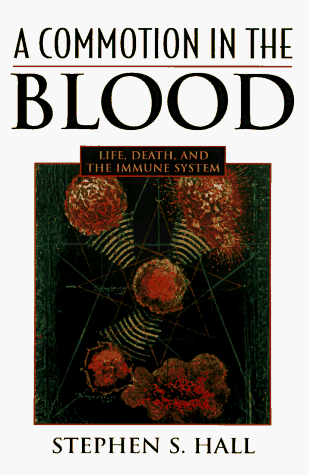
Describes how doctors have learned to use the immune system and its irregularities to develop a wide range of innovative treatments for disease, and the biological & political complexities that make the process tough-going
Reviews
Immunotherapy seeks to get the immune system to stir up a molecular ``commotion in the blood'' to battle disease. This sweeping yet remarkably detailed report focuses on the efforts to use immunotherapy in the fight against cancer. Science journalist Hall (Mapping the Next Millennium, 1991, etc.) opens with an account of William Coley, a 19th-century American physician whose pioneering use of a crude cancer vaccine can now be seen as the beginning of cancer immunotherapy in this country. As Hall points out, neither Coley nor his critics had ``the foggiest notion of the cells, the molecules, and the order of interaction involved in the immune response,'' an ignorance that today is finally lifting. The scene next shifts to 1950s London and the discovery of the much-ballyhooed interferon, which in turn led to the discovery of a host of other factors involved in immunological responses. Among these are interleukin-2, discovered in 1976 in one of Robert Gallo's laboratories and made famous by Steven Rosenberg in his work at the National Cancer Institute, and interleukin-12, the current favorite. Along the way, Hall details the development of T-cell-specific antibodies, the tumor necrotizing factor, and monoclonal antibodies. He seems to have interviewed just about every major immunology researcher, and he makes vivid their political maneuverings in the race for scientific primacy. The journey of a new therapeutic tool from laboratory to clinic is a hazardous one, and Hall makes it both understandable and exciting. He also shows us the hype that surrrounds each new ``magic bullet'' and the inevitable letdown when each one fails to live up to its hype. In the end, Hall leaves the reader optimistic that the ``commotion in the blood'' is not random noise but a ``beautifully scored piece of music'' that future researchers will be able to read. As gripping as a spy thriller. (8 pages b&w photos, not seen) -- Copyright ©1997, Kirkus Associates, LP. All rights reserved.
Hall tells the exciting, involved, century-long story of cancer therapy and the immune system--a highly technical subject--excellently, bringing the personalities and careers of great researchers and clinicians to life. He starts at the beginning of the twentieth century, with William Coley and his vaccines, which were at first derided, then forgotten, but finally became the basis for much future investigation. Other stars include the dour James Ewing, the bouncy optimist Alick Isaacs, the put-upon Doris Morgan, and, above all, the restlessly innovative and aggressive Stephen Rosenberg. Hall also looks at the business side of therapeutic development; using tumor necrosis factor as an example, he shows how the marketing of scientific products can get out of hand and damage the effectiveness of later investigations. Many current and future medical news items will be clearer to readers of this fascinating, detailed, well-documented book. William Beatty
In his latest book, science journalist Hall (Mapping the Next Millennium, LJ 12/91) chronicles the history of immunotherapy as a treatment for cancer. He begins with a discussion of William Coley's early attempts to treat cancer by deliberately injecting patients with a bacterial culture. He then examines numerous critical advances in the science of immunotherapy such as the discovery of cytokines and the impact of molecular genetics. Hall concludes with a lengthy review of some of the latest attempts at immunotherapy, including monoclonal antibodies, adoptive immunotherapy, and interleukin-12. The author does an admirable job of explaining the extremely complicated subject of immunology in understandable terminology. While much is still to be learned in this area, this book gives the reader a true appreciation of the complexity of human immunity?the "commotion in the blood" is not chaotic but rather a beautifully orchestrated intricate system. Highly recommended for all libraries.?Tina Neville, Univ. of South Florida at St. Petersburg Lib.
Copyright 1997 Reed Business Information, Inc.
"About this title" may belong to another edition of this title.