Synopsis
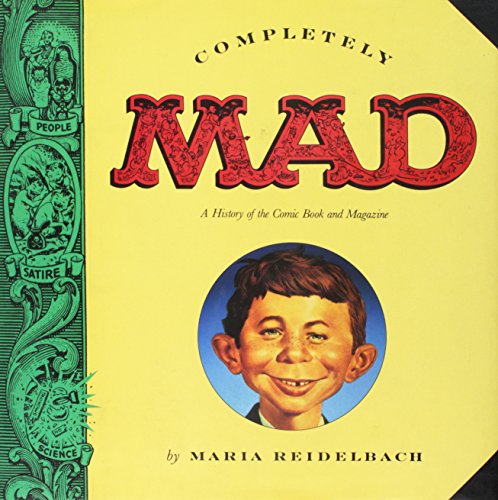
Text and illustrations trace the history of Mad magazine, from its beginning in 1952 to the present, and profile the artists, writers, and editors who created and worked on it
Reviews
YA-- A zany celebration of 40 years of MAD that should please ardent fans and attract browsers with its madcap illustrations that include reproductions of every cover since 1952.
Copyright 1992 Reed Business Information, Inc.
Publisher Bill Gaines and editor Harvey Kurtzman produced the first issue of Mad magazine in 1956 and American satirical humor has never been the same since. Beginning with the comic book company founded by his father, Max, Gaines transformed his father's wholesome comics lines into EC Comics, the profitable publisher of classic 1950s' horror comics, and later introduced Mad and its mascot, the "What Me Worry" kid, Alfred E. Neuman. Although basically celebratory and uncritical, art historian Reidelbach's detailed history of Mad mentions recent criticisms of sexist and homophobic material in the magazine as well as Mad 's (and the comics industry's) contested policies on the ownership of commissioned artwork. Most amusing are descriptions of Gaines--who continues to run the profitable magazine as a "benevolent dictatorship"--and his idiosyncratic management theories ( Mad accepts no advertising, has never conducted a reader survey and does little merchandising). The book is chock-full of Mad material--the usual "trash," as Mad always describes its own contents--as well as information on the many freelance artists and writers who have worked for the magazine.
Copyright 1991 Reed Business Information, Inc.
This copiously illustrated history of America's ``most successful humor magazine'' never takes itself too seriously, despite patches of banal social history and cultural analysis. Lots of sidebars cover all sorts of material Reidelbach (Miniature Golf, 1987--not reviewed) couldn't integrate into her main narrative, especially profiles of Mad's legendary publisher, William Gaines, and biographies of the many talented writers and illustrators he's employed over the years. Anarchic, irreverent, cynical, and absurdist, Mad began its nearly 40-year history as a four-color comic book edited by Harvey Kurtzman, who brought a new level of satiric sophistication to a medium reserved mostly for superhero dreck and cute funny animals. In fact, the early Mad parodied the funny pages with the same cleverness it would later bring to bear on advertising, movies, and TV. When the comic-book industry imposed new restrictions on itself in the mid-50's, Gaines transformed Mad into a magazine rather than submit it to the censors. While Kurtzman left for other projects, Gaines and his new editor, Al Feldstein, made Mad more accessible to a wider audience. Circulation grew from 325,000 to a high of 2.5 million, with a worldwide readership (in numerous translations and adaptations). Published domestically every 45 days, and with no advertising, Mad provoked the ire of social watchdogs everywhere- -nothing seemed sacred to the self-described ``usual gang of idiots'' who mocked the many icons of modern life. Serious cultural critics like Marshall McLuhan, Paul Goodman, and Dwight Macdonald all found the popular humor mag worthy of analysis as a genuine reflection of tumultuous times. Reidelbach strains when she describes Mad's worry-less mascot, Alfred E. Neuman, as ``an archetype of the Jungian sort,'' and her imitations of the Mad style are as annoying as the book's cluttered design. Nevertheless, it's a fine overview of a vital part of pop culture, and a must-read for true Mad ``fan-addicts.'' (350 color photographs, 200 b&w drawings.) -- Copyright ©1991, Kirkus Associates, LP. All rights reserved.
Art historian Reidelbach's history of Mad magazine is arranged thematically--which makes sense, since the magazine has changed little in 40 years, making a chronological approach superfluous. Only occasionally critical (touching briefly on the shortage of female points of view, periodic homophobia, and publisher William M. Gaines's controversial management style), Reidelbach examines the different things Mad has done, and been accused of doing, and the tremendous influence it has had on the field of satire and the American consciousness. The book is profusely illustrated, well researched, and has numerous sidebars profiling the many Mad contributors over the years: creator Harvey Kurtzman, Gaines, and the rest of "the usual gang of idiots." What makes the book stand out, however, is the remarkable and imaginative layout by Alexander Isley Design, using different typefaces and the occasional right angle to differentiate main text from sidebars, captions, and pithy quotes. Essential for pop culture collections; a discretionary purchase for public and academic libraries.
- Keith R.A. DeCandido, "Library Journal"
Copyright 1991 Reed Business Information, Inc.
"About this title" may belong to another edition of this title.