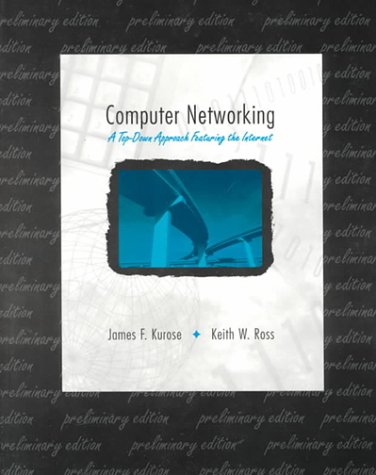
Computer Networking: A Top-Down Approach Featuring the Internet
James F. Kurose,Keith W. Ross
ISBN 10: 0201612747 ISBN 13: 9780201612745
Published by Addison Wesley Publishing Comp, 2000
Used
paperback
From
HPB-Red, Dallas, TX, U.S.A.
Seller rating 5 out of 5 stars

AbeBooks Seller since March 11, 2019
This specific item is no longer available.
About this Item
Description:
Connecting readers with great books since 1972! Used textbooks may not include companion materials such as access codes, etc. May have some wear or writing/highlighting. We ship orders daily and Customer Service is our top priority! Seller Inventory # S_290698778
Synopsis:
Certain data-communication protocols hog the spotlight, but all of them have a lot in common. Computer Networking: A Top-Down Approach Featuring the Internet explains the engineering problems that are inherent in communicating digital information from point to point. The top-down approach mentioned in the subtitle means that the book starts at the top of the protocol stack--at the application layer--and works its way down through the other layers, until it reaches bare wire.
The authors, for the most part, shun the well-known seven-layer Open Systems Interconnection (OSI) protocol stack in favor of their own five-layer (application, transport, network, link, and physical) model. It's an effective approach that helps clear away some of the hand waving traditionally associated with the more obtuse layers in the OSI model. The approach is definitely theoretical--don't look here for instructions on configuring Windows 2000 or a Cisco router--but it's relevant to reality, and should help anyone who needs to understand networking as a programmer, system architect, or even administration guru.
The treatment of the network layer, at which routing takes place, is typical of the overall style. In discussing routing, authors James Kurose and Keith Ross explain (by way of lots of clear, definition-packed text) what routing protocols need to do: find the best route to a destination. Then they present the mathematics that determine the best path, show some code that implements those algorithms, and illustrate the logic by using excellent conceptual diagrams. Real-life implementations of the algorithms--including Internet Protocol (both IPv4 and IPv6) and several popular IP routing protocols--help you to make the transition from pure theory to networking technologies. --David Wall
Topics covered: The theory behind data networks, with thorough discussion of the problems that are posed at each level (the application layer gets plenty of attention). For each layer, there's academic coverage of networking problems and solutions, followed by discussion of real technologies. Special sections deal with network security and transmission of digital multimedia.
Review: Certain data-communication protocols hog the spotlight, but all of them have a lot in common. Computer Networking: A Top-Down Approach Featuring the Internet explains the engineering problems that are inherent in communicating digital information from point to point. The top-down approach mentioned in the subtitle means that the book starts at the top of the protocol stack--at the application layer--and works its way down through the other layers, until it reaches bare wire.
The authors, for the most part, shun the well-known seven-layer Open Systems Interconnection (OSI) protocol stack in favor of their own five-layer (application, transport, network, link, and physical) model. It's an effective approach that helps clear away some of the hand waving traditionally associated with the more obtuse layers in the OSI model. The approach is definitely theoretical--don't look here for instructions on configuring Windows 2000 or a Cisco router--but it's relevant to reality, and should help anyone who needs to understand networking as a programmer, system architect, or even administration guru.
The treatment of the network layer, at which routing takes place, is typical of the overall style. In discussing routing, authors James Kurose and Keith Ross explain (by way of lots of clear, definition-packed text) what routing protocols need to do: find the best route to a destination. Then they present the mathematics that determine the best path, show some code that implements those algorithms, and illustrate the logic by using excellent conceptual diagrams. Real-life implementations of the algorithms--including Internet Protocol (both IPv4 and IPv6) and several popular IP routing protocols--help you to make the transition from pure theory to networking technologies. --David Wall
Topics covered: The theory behind data networks, with thorough discussion of the problems that are posed at each level (the application layer gets plenty of attention). For each layer, there's academic coverage of networking problems and solutions, followed by discussion of real technologies. Special sections deal with network security and transmission of digital multimedia.
"About this title" may belong to another edition of this title.
Bibliographic Details
Title: Computer Networking: A Top-Down Approach ...
Publisher: Addison Wesley Publishing Comp
Publication Date: 2000
Binding: paperback
Condition: Good
Top Search Results from the AbeBooks Marketplace

Stock Image
Computer Networking : A Top-down Approach Featuring the Internet
Published by
Addison-Wesley Longman, Incorporated, 1999
ISBN 10: 0201612747
ISBN 13: 9780201612745
Used
Softcover
Seller: Better World Books, Mishawaka, IN, U.S.A.
Seller rating 5 out of 5 stars
Condition: Good. Preliminar. Used book that is in clean, average condition without any missing pages. Seller Inventory # 5723545-6
Stock Image
Computer Networking : A Top-down Approach Featuring the Internet
Published by
Addison-Wesley Longman, Incorporated, 1999
ISBN 10: 0201612747
ISBN 13: 9780201612745
Used
Softcover
Seller: Better World Books, Mishawaka, IN, U.S.A.
Seller rating 5 out of 5 stars
Condition: Very Good. Preliminar. Used book that is in excellent condition. May show signs of wear or have minor defects. Seller Inventory # 53299876-6
Stock Image
Computer Networking: A Top-Down Approach Featuring the Internet
Published by
Addison Wesley Publishing Comp, 2000
ISBN 10: 0201612747
ISBN 13: 9780201612745
Used
Softcover
Seller: Used Book Company, Egg Harbor Township, NJ, U.S.A.
Seller rating 5 out of 5 stars
Condition: Good. A copy that has been read, but remains in clean condition. Shows signs of wear and previous use. May include writing/highlighting, library labels, stickers, shelf/handling wear, damages to pages/spine/binding/cover, and other defects. May not include the dust jacket or supplementary material (toys, access code, dvds, etc). A portion of your purchase benefits nonprofits! - STOCK PHOTO, ITEM DETAILS (PUBLICATION YEAR, FORMAT, ETC) OTHER INFO MAY BE INACCURATE. PRODUCTS ACTUAL EDITION, ITEM DETAILS FORMAT MAY DIFFER FROM WHAT IS SHOWN. INFO/PHOTOS PROVIDED UPON REQUEST. Seller Inventory # 584R0H0000D3_ns
Stock Image
Computer Networking: A Top-Down Approach Featuring the Internet
Published by
Addison Wesley Publishing Comp, 2000
ISBN 10: 0201612747
ISBN 13: 9780201612745
Used
Softcover
Seller: GCCebooks, Salinas, CA, U.S.A.
Seller rating 5 out of 5 stars
Condition: Good. The cover and pages show normal wear. Book edges have stains. The book has a creased cover. Seller Inventory # 3UAP3I002FII