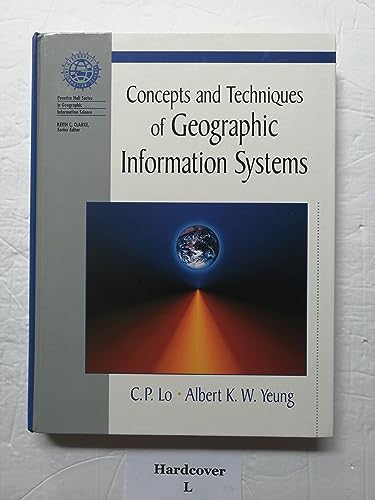
Emphasizing a balance between theory and technique, this book gives professionals a comprehensive and up-to-date review of the skills and concepts they need to use GIS in all its forms and implementations. Provides complete coverage of the concepts and techniques pertaining to every stage of the systems development life cycle of GIS and its applications in various areas of spatial problem solving and decision making. Includes topics that are not usually covered in other GIS texts, such as, the principles and practice of information resource management, information systems development methodology, spatial database modeling and design, and more. For GIS specialists, GIS technologists, GIS sales directors, urban planners, natural resource managers, land surveyors, geomatics engineers, and foresters who want a complete understanding of GIS and how GIS applies to their fields of interest.
This book on Geographic Information Systems (GIS) provides a rigorous but balanced treatment of concepts and techniques in a single volume. GIS has evolved from a mapping and spatial analytical tool in geography to become a full-fledged professional practice. There is now a proliferation of educational programs from universities and colleges that purport to certify or accredit the proficiency of their graduates' GIS skills in the workplace.
GIS is a multidisciplinary science. GIS practitioners may be geographers, planners, surveyors, or computer scientists. Despite the diversity in approaches, GIS has a special set of skills and knowledge needed by the professionals to use GIS in all its forms and implementations. This book is an attempt to define the set of skills and concepts for GIS professionals. One of us is a GIS practitioner who has over 20 years of work experience in the academic and public sectors as well as the private consulting industry in Hong Kong and Canada. The other is an academic with over 30 years of research and teaching experience in photogrammetry, remote sensing, and GIS in universities in the United Kingdom, Hong Kong, and the United States. We put our experience to work for this book with the hope that it will be useful to both geographic information practitioners and scientists.
We approach the study of GIS from the broader context of information technology in general, and information resource management in particular, because current GIS development is driven primarily by the needs of the business and public sectors, as evidenced by large databases, client/server computing architecture, national geospatial infrastructure, and the deployment of the Internet for disseminating geographic information by business organizations and all levels of government agencies. Such a change of perspective has led to the expansion of the scope of the study of GIS, from a narrow focus on technology-pushed applications in the past, to a broad-based approach emphasizing the total integration of data, technical, and human resources within the framework of information technology today. Our book therefore includes topics that are not always adequately covered in earlier GIS textbooks, such as the principles and practice of information resource management, information system development methodology, spatial database modeling and design, as well as the implementation of GIS in the enterprise information technology environment. This book attempts to provide a complete coverage of the concepts and techniques pertaining to every stage of the systems development life cycle of GIS and its applications in various areas of spatial problem solving and decision making.
As GIS is a subject that needs to be learned hands-on, an accompanying laboratory manual has been produced. Each laboratory exercise has been designed to relate to the major concepts covered in each chapter of the book. Students can use real-world data and appropriate G1.S software to perform tasks using personal computers taking a period of about two hours. The data are chosen so that they can be easily substituted. These laboratories are not designed for teaching a specific GIS software package.
The emphasis of the book is rigor and balance. Rigor demands accuracy and detail. Balance provides a broad perspective that covers applications in both the physical and social sciences. The book has been designed for use in a 15-week semester, but it may be readily adapted to a 10-week quarter. It is assumed that students have a basic high school mathematical background in geometry, algebra, and trigonometry, as well as some knowledge of computer science. A good grounding in geography (or any science related to the study of the spatial distribution of features and phenomena) is essential.
Because GIS is such a rapidly changing technology, anything written may be out of date very quickly. The book has a Web site devoted to updating the contents of this book after its publication and to providing resources for its use in the classroom. We will try our best to ensure the accuracy and timeliness of the materials covered in the book. We appreciate comments and criticisms from readers so that we can improve the books in subsequent editions.