About this Item
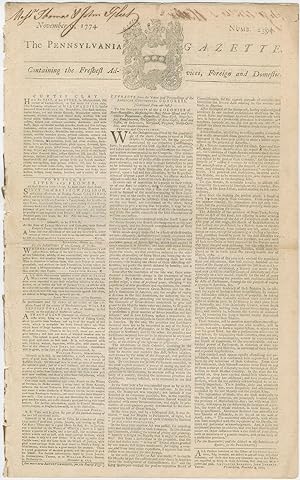
Newspaper. Pennsylvania Gazette, November 9, 1774 (No. 2394). Philadelphia: David Hall and William Sellers. Front-page printing of Memorial To the Inhabitants of the Colonies of New-Hampshire, Massachusetts Bay, Rhode-Island, and Providence Plantations, Connecticut, New-York, New-Jersey, Pennsylvania, the Counties of New-Castle, Kent, and Sussex, on Delaware, Maryland, Virginia, North Carolina, and South Carolina (October 21, 1774); and Letter To the Inhabitants of the Province of Quebec (October 26, 1774). Copy sent to Thomas and John Fleet, Boston printers. 4 pp. 10 x 16 1/4 in. "Friends and Countrymen:. we find ourselves reduced to the disagreeable alternative, of being silent and betraying the innocent, or of speaking out and censuring those we wish to revere. In making our choice of these distressing difficulties, we prefer the course dictated by honesty, and a regard for the welfare of our country.""it is clear beyond a doubt, that a resolution is formed, and now is carrying into execution, to extinguish the freedom of these colonies, by subjecting them to a despotic government." See Postscript from the same date, offered separately, with the Articles of Association and the Address "To the People of Great-Britain" written by John Jay.On October 11, 1774, the Continental Congress resolved unanimously that "a memorial be prepared for the people of British America, stating to them the necessity of a firm, united, and invariable observation of the measures recommended by the Congress, as they tender the invaluable rights and liberties derived to them from the laws and constitution of their country." Congress appointed Richard Henry Lee of Virginia, William Livingston of New Jersey, and John Jay of New York as a committee to prepare both this memorial and a separate Address to the People of Great Britain. Lee prepared a first draft of the Memorial, while Jay wrote a first draft of the Address. On October 18 and 19, Congress considered a draft of the Address, and suggested amendments.In order to encourage participation in "The Association," the Memorial to the inhabitants of the American colonies recited the acts of Parliament to which Congress objected and which would "extinguish the freedom of these Colonies by subjecting them to a despotic Government." The Memorial also justified the "commercial mode of opposition" as one that would prove both "efficacious" and not preclude "a hearty reconciliation with our fellow-citizens on the other side of the Atlantic."On October 20-21, Congress considered and debated the draft Memorial by paragraphs, amended it, and ordered that it "be immediately committed to the press & that no more than one hundred and twenty copies.be struck off without further orders from the Congress."On October 21, Congress also resolved to send an address to the people of Quebec, and letters to the colonies of St. John's, Nova Scotia, Georgia, East Florida, and West Florida, "who have not deputies to represent them in this Congress." They appointed Thomas Cushing of Massachusetts, Richard Henry Lee of Virginia, and John Dickinson of Pennsylvania as a committee to prepare the address and letters. On October 24, the committee presented a draft, which Congress debated and re-committed to the committee. On October 26, Congress debated a revised draft by paragraphs, amended it, and then approved it.This letter was the first of three letters sent by the Continental Congresses in 1774, 1775, and 1776 directly to the people of the Province of Quebec. Despite the repeated appeals of the Continental Congresses for them to join the American revolutionary cause, Quebec and the other northern provinces of St. John's (Prince Edward Island) and Nova Scotia remained loyal to Great Britain. At the time, the Province of Quebec included much of modern southern and eastern Quebec, southeastern Ontario, Labrador, and the future American states of Ohio, Indiana, Michigan, and portions . (See website for full description).
Seller Inventory # 30035.20
Contact seller
Report this item