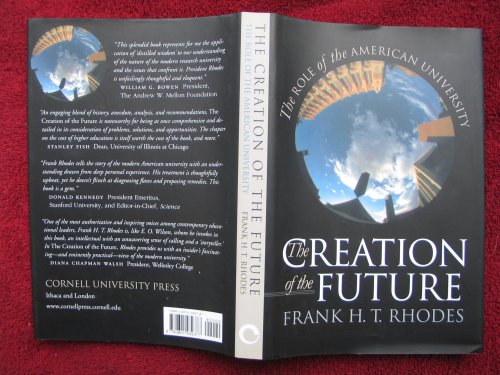
The Creation of the Future (Hardcover)
Frank H.T. Rhodes
Sold by Grand Eagle Retail, Bensenville, IL, U.S.A.
AbeBooks Seller since October 12, 2005
New - Hardcover
Condition: New
Ships within U.S.A.
Quantity: 1 available
Add to basketSold by Grand Eagle Retail, Bensenville, IL, U.S.A.
AbeBooks Seller since October 12, 2005
Condition: New
Quantity: 1 available
Add to basketHardcover. Is the university a dinosaur: huge, lumbering, endearing in its own way, yet unsuited to today's world? Is it a thing of the past, unnecessary in an age of the Internet and online learning? In a book likely to provoke people who are loyal to the ideal of the university as well as those who foresee its demise, Frank H. T. Rhodes acknowledges that the university is an imperfect institution, but argues that it plays an essential role in modern society. In the process, he articulates strong opinions on a range of difficult issues. The Creation of the Future is no defense or promotion of the status quo. Focusing on American research universities, Rhodes makes the case that they are an irreplaceable resource, quite literally a national and international treasure, whose value must be preserved through judicious renewal and reform, beginning with a rededication to teaching as a moral vocation. Rhodes discusses where the research university is today and how it got here, as well as where it must go in the future.In the process, he addresses a wide range of contemporary challenges facing the institution, including*why universities can no longer be "ivory towers"*why post-tenure review of professors is desirable*whether grading standards have become too lax*why unionization of graduate students is inappropriate*why affirmative action is necessary*how governance and leadership can be improved*how to maintain a sense of commitment to the university in the face of increasing disciplinary specialization*why faculty must affirm that university membership has not only its privileges, but also its price.*what should and should not be done to control the rapid rise in tuition.*whether curricula of professional schools should be more heavily weighted toward the liberal arts.*why service is a social obligation of all universities, not just land-grant institutions.*why research is vital to effective teaching.His eighteen-year tenure as president of Cornell University gives Rhodes a unique perspective on a system he finds both invaluable and in need of change. Although he is an enthusiastic advocate, he pulls no punches in recommending sweeping changes.The greatest catastrophe facing universities today, he writes, is loss of community: "Without community, knowledge becomes idiosyncratic. The lone learner, studying in isolation, is vulnerable to narrowness, dogmatism, and untested assumption; pursued in community, learning will be expansive and informed, contested by opposing interpretations, leavened by differing experience, and refined by alternative viewpoints."In championing a new relevance for the American research university, Rhodes argues for renewal through the application of old virtues to new realities. Campus culture, he says, must embrace the human experience in all its richness, breadth, and ambiguity if it is to survive and thrive. Is the university a dinosaur: huge, lumbering, endearing in its own way, yet unsuited to today's world? Is it a thing of the past, unnecessary in an age of the Internet and online learning? In a book likely to provoke people who are loyal to the ideal. Shipping may be from multiple locations in the US or from the UK, depending on stock availability.
Seller Inventory # 9780801439377
Is the university a dinosaur: huge, lumbering, endearing in its own way, yet unsuited to today's world? Is it a thing of the past, unnecessary in an age of the Internet and online learning? In a book likely to provoke people who are loyal to the ideal of the university as well as those who foresee its demise, Frank H. T. Rhodes acknowledges that the university is an imperfect institution, but argues that it plays an essential role in modern society. In the process, he articulates strong opinions on a range of difficult issues.
The Creation of the Future is no defense or promotion of the status quo. Focusing on American research universities, Rhodes makes the case that they are an irreplaceable resource, quite literally a national and international treasure, whose value must be preserved through judicious renewal and reform, beginning with a rededication to teaching as a moral vocation.
Rhodes discusses where the research university is today and how it got here, as well as where it must go in the future. In the process, he addresses a wide range of contemporary challenges facing the institution, including
*why universities can no longer be "ivory towers"
*why post-tenure review of professors is desirable
*whether grading standards have become too lax
*why unionization of graduate students is inappropriate
*why affirmative action is necessary
*how governance and leadership can be improved
*how to maintain a sense of commitment to the university in the face of increasing disciplinary specialization
*why faculty must affirm that university membership has not only its privileges, but also its price.
*what should and should not be done to control the rapid rise in tuition.
*whether curricula of professional schools should be more heavily weighted toward the liberal arts.
*why service is a social obligation of all universities, not just land-grant institutions.
*why research is vital to effective teaching.
His eighteen-year tenure as president of Cornell University gives Rhodes a unique perspective on a system he finds both invaluable and in need of change. Although he is an enthusiastic advocate, he pulls no punches in recommending sweeping changes. The greatest catastrophe facing universities today, he writes, is loss of community: "Without community, knowledge becomes idiosyncratic. The lone learner, studying in isolation, is vulnerable to narrowness, dogmatism, and untested assumption; pursued in community, learning will be expansive and informed, contested by opposing interpretations, leavened by differing experience, and refined by alternative viewpoints."
In championing a new relevance for the American research university, Rhodes argues for renewal through the application of old virtues to new realities. Campus culture, he says, must embrace the human experience in all its richness, breadth, and ambiguity if it is to survive and thrive.
Frank H. T. Rhodes is President Emeritus of Cornell University. A geologist by training, his numerous published works on geology and education include the books The Evolution of Life and Language of the Earth. He holds the Bigsby Medal of the Geological Society and the Clark-Kerr Medal of the University of California-Berkeley. He currently serves as President of the American Philosophical Society and as Chairman of the Board of the Atlantic Foundation. He is the past chairman of the National Science Board and the boards of the American Council on Education, the Association of American Universities, and the Carnegie Foundation for the Advancement of Teaching. He holds more than thirty honorary degrees from universities both in this country and abroad.
"About this title" may belong to another edition of this title.
We guarantee the condition of every book as it¿s described on the Abebooks web sites. If you¿ve changed
your mind about a book that you¿ve ordered, please use the Ask bookseller a question link to contact us
and we¿ll respond within 2 business days.
Books ship from California and Michigan.
Orders usually ship within 2 business days. All books within the US ship free of charge. Delivery is 4-14 business days anywhere in the United States.
Books ship from California and Michigan.
If your book order is heavy or oversized, we may contact you to let you know extra shipping is required.
| Order quantity | 6 to 16 business days | 6 to 14 business days |
|---|---|---|
| First item | US$ 0.00 | US$ 0.00 |
Delivery times are set by sellers and vary by carrier and location. Orders passing through Customs may face delays and buyers are responsible for any associated duties or fees. Sellers may contact you regarding additional charges to cover any increased costs to ship your items.