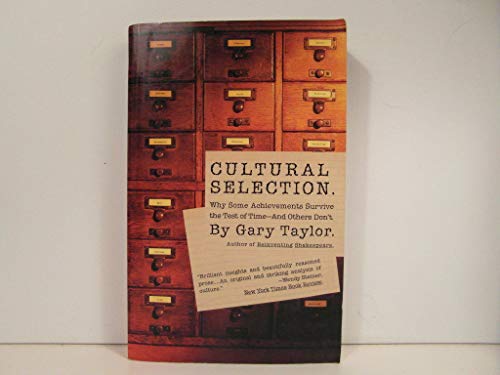
Acclaimed literary scholar Gary Taylor creates a new paradigm for understanding cultural history. He argues that culture is not what was done, but what is remembered and that the social competition among different memories is as dynamic as the biological struggle for survival. Taylor builds his argument on a broad base of cultural achievements, from Michelangelo to Frankenstein, from Shakespeare to Casablanca, from Freud to Invisible Man. He spans the continents to draw upon Japanese literature, Native American history, ancient Greek philosophy, and modern American architecture.
Taylor, a Shakespeare scholar at the University of Alabama, believes that "culture is not what was done but what is passed on ... it is always motivated, always mediated." The passing on is done by "editors": publishers, reviewers, teachers, and curators. In Cultural Selection, Taylor examines the function of the editor, whose role, he says, is not unlike that of the politician in a democracy, which is to "represent other people."