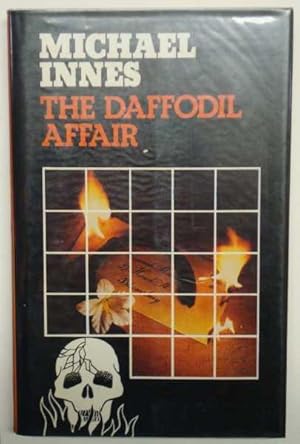
Light after light goes out, including two luminaries from Scotland Yard.
In the midst of the Blitz, a house in Bloomsbury disappears. In York and London, two young girls have been kidnapped. And in Harrogate, a cab horse named Daffodil has gone missing.
Appleby is sent to look into the Daffodil affair, while vice detective Hudspith investigates the cases of human trafficking. But they must work in tandem to piece this mystery together. And they soon find that the links among the disappearances are odder than they could possibly the house is haunted, one is girl a witch, the other has multiple personalities, and the horse can count. Whoever is behind this is trafficking in marvels.
Appleby and Hudspith pursue their victims deep into the South American jungle where they discover the terrifying sprawl of this bizarre vision. Surrounded by rivers filled with alligators and the swirling mist of the Amazon, the pair are confronted with questions of magic and the supernatural. But when the madman’s machinations turn to the two police officers, Appleby must race against the clock to stop this weird experiment before it costs him his life.
Born in Edinburgh in 1906, the son of the city's Director of Education, John Innes Mackintosh Stewart wrote a highly successful series of mystery stories under the pseudonym Michael Innes. Innes was educated at Oriel College, Oxford, where he was presented with the Matthew Arnold Memorial Prize and named a Bishop Frazer's scholar. After graduation, he went to Vienna to study Freudian psychoanalysis for a year and following his first book, an edition of Florio's translation of 'Montaigne', was offered a lectureship at the University of Leeds. In 1932 he married Margaret Hardwick, a doctor, and they subsequently had five children including Angus, also a novelist. The year 1936 saw Innes as Professor of English at the University of Adelaide, during which tenure he wrote his first mystery story, 'Death at the President's Lodging'. With his second, 'Hamlet Revenge', Innes firmly established his reputation as a highly entertaining and cultivated writer. After the end of World War II, he returned to the UK and spent two years at Queen's University, Belfast, where in 1949 he wrote the 'Journeying Boy', a novel notable for the richly comedic use of an Irish setting. He then settled down as a Reader in English Literature at Christ Church, Oxford, from which he retired in 1973. Innes's most famous character is 'John Appleby', who inspired a penchant for donnish detective fiction that lasts to this day. His other well-known character is 'Honeybath', the painter and rather reluctant detective, who first appeared in 1975 in 'The Mysterious Commission'. The last of the Innes novels, 'Appleby and the Ospreys', was published in 1986, some eight years before his death in 1994. His work is still very highly regarded and 'Appleby's End' and 'The New Sonia Wayward' were chosen by H.R.F. Keating as being amongst the best 100 crime novels ever written. The 'Times Literary Supplement' said of him: 'A Master - he constructs a plot that twists and turns like an electric eel: it gives you shock upon shock and you cannot let go.