Synopsis
“Powerful . . . A combustible mixture of science and mysticism, a high-altitude
thriller fizzing with intrigue.” –JOHN CASE, Author of The Eighth Day
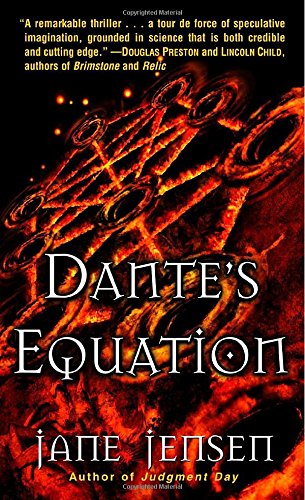
In a breathless thriller that explores the relationship between science and the divine, good and evil, space and time, Jane Jensen takes us from the world we know into a reality we could only scarcely imagine. Until now.
Rabbi Aharon Handalman’s expertise with Torah code–rearranging words and letters in the Bible–has uncovered a man’s name. Who is Yosef Kobinski, and why did God hide his name in His sacred text? To find the answers, Aharon begins an investigation, and discovers that Kobinski, a Polish rabbi, was not only a mystic but also a brilliant physicist who authored what may be the most important lost work in human history.
In Seattle, Jill Talcott’s work with energy wave equations is being linked to Yosef Kobinski, now deceased, who claimed nearly fifty years ago that he discovered an actual physical law of good and evil. But when Jill’s lab explodes, she is forced to flee for her life, realizing that her cutting-edge research is far more dangerous than she ever has imagined. And that powerful people have a stake in what she may have uncovered.
Now Jill, her research partner, and a writer fascinated by Kobinski are about to meet Handalman in Poland–all four desperate to solve the astonishing riddle. Searching through the past, they trace Kobinski to a clearing in the woods near Auschwitz. And in that clearing they come face-to-face with the inexplicable: that Kobinski, drawing on his own alchemy of science and the Kabbalah, made himself vanish from the death camp in a blaze of fire. Now, with intelligence agents hot on their trail, the investigators have no choice. They must follow Kobinski –to wherever he may have gone. . . .
From the Trade Paperback edition.
Excerpt. © Reprinted by permission. All rights reserved.
1
We are like Midas . . . Humans can never experience the true texture of quantum reality because everything we touch turns to matter.
—Physicist Nick Herbert
1.1. Denton Wyle
March Aboard the Coast Guard MLB Invincible II, off the coast of Florida
Denton Wyle was seriously reexamining his choices. His fingers were wrapped like living clamps around a pole, his blond hair dribbled water down his patrician nose, and his back pressed hard against the cabin of the rescue ship as sea spray slapped him on the cheeks like an outraged Englishman and the deck beneath his feet pitched like a bucking bronco.
He was on a ship, in a storm, smack dab in the Bermuda Triangle.
The Coast Guard crewmen, bright orange specks in a wet, gray world, moved about the tilting slippery deck with ease. They were on a mission to locate a yacht, the Why Knot Now, in distress off the Florida Keys. A sailing ad- visory was in effect and the yacht, manned by a couple and their teenage daughter, had radioed that their compass appeared to be in error, because they were lost and didn’t know which way to go to find land.
It was the call Denton had been waiting for, hanging out in the Coast Guard station for weeks now, schmoozing with men who had sea salt in their eyebrows. A bad compass? A lost vessel? Denton Wyle, intrepid reporter for Mysterious World, was all over it.
Only now he realized, as his fingers spasmed from being clenched so tightly around the pole, that the two key words in this entire scenario were not bad compass or even Bermuda Triangle but sailing advisory. Sailing advisory meaning: “our advice is, don’t go out on a freaking ship.”
“Wyle?” A rain-soaked face in a blue hard hat appeared. It was Frank, a burly New Yorker. Denton had spent an afternoon watching him hose down nylon netting.
“Yeah?”
“Get. Inside. The cabin.” The words were shouted over the howl of the wind and symphonic crash of waves. Frank hung lightly with one hand to the pole just above Denton’s white knuckles. With the other he jabbed an index finger at the cabin behind them.
“I’m fine,” Denton shouted back, because moving anywhere meant letting go of the pole.
But Frank had been trained in dealing with the hapless. He grabbed Denton’s upper arm and pulled. Behind Frank the side of the rescue boat was tilted at a forty-five-degree angle, and its thin, insubstantial metal rail kept dipping in and out of churning water. Denton could so clearly imagine sliding into that maw if he let go, just like the scene from Jaws where the fishing boat captain slides down the deck into the shark’s mouth.
“Come on!” Frank yelled.
Denton let go. There was a panicked moment of sliding feet; then the cabin door was in his hand and Frank shoved him through, slamming the door behind him.
Inside, Denton stood panting, trying to get a firmer grip on his breakfast. He made no pretensions of bravery. The right stuff had been left out of his genetic code; he could admit that. But he was also not a boat person. Even growing up on the shores of Massachusetts, where yachting clubs got better attendance on Sundays than churches, he had not liked boats. What on earth had he been thinking?
He hadn’t been thinking about the Bermuda Triangle or the sea. He’d been thinking about woods, about a little girl and flashes of light.
The rain lashed the windows so hard you couldn’t see a thing on deck from inside the cabin, only great watery swells as they blocked out the sky.
“They keep fading in and out of radar,” one of the crewmen reported.
Captain Dodd looked from the window to the radar screen and back again, peering out with squinting eyes. “How far?”
“About five hundred meters.”
“Move closer. Slowly.” Dodd never took his eyes off that window.
Denton found this conversation curious enough to nudge awake his reporter’s instincts. He remembered the camera that had been flopping around on his chest for the past hour. He dried it with his sleeve and took some snapshots. It made him feel a little better.
“Damn it, we should have a visual by now!” Dodd stomped to a rack of gear and grabbed a rain poncho. “I’m goin’ out. I’ll send Johnson in to watch for my signal.”
The wind intensified as the door opened and closed. Denton moved in to get a tight shot of the radar screen. He didn’t recognize the operator, a baby-faced kid, no more than nineteen. He seemed amazingly unafraid, unfazed by the heaving deck beneath them or the towering waves above. He was intent on trying to tune in a better signal.
“Which blip is theirs?” Denton asked, teeth chattering.
The operator pointed to a faint ping, barely there. For a few seconds it went away; then it reappeared.
“We’re not sure that’s them, but we’re close to their last recorded position.” The kid looked up. “You okay?”
“Fine.”
“You look chalky.”
“I’m . . .” Denton glanced up and saw a gigantic wall of water. The wave slipped beneath them with a pitch and roll. “. . fine. Look, does the radar usually do that? Fade in and out?”
The operator looked around, as if someone else could answer for him. “It’s not supposed to, but this is pretty bad weather.”
The wind blasted again as Johnson came in and took up a position by the window. Denton watched the blip disappear. This time, it didn’t come back.
And it didn’t come back.
He felt a rising sense of excitement at the sight of that dead screen. A headline was taking shape in his head: Coast Guard Witnesses Disappearance of Vessel on Radar in Bermuda Triangle. He took more pictures, struggled to see out the window.
Johnson held up a hand. “Starboard! Thirty degrees!”
The atmosphere in the cabin changed instantly from one of grim worry to confidence and competency. It was amazing what the willpower of man could do, Denton reflected, even in the face of something as elemental as this storm. The ship turned, the men shouting instructions, working as one. Their energy was so intense that for a moment he glimpsed what it would be like to be one of these boatmen, mastering the great watery tide.
There was a flash of another vessel in the window, but it disappeared in the rain and waves. Denton couldn’t see a damn thing in here. He had to go outside.
Now that the ship had turned, the deck was tilting the other way and Denton had no problem grabbing the pole from the cabin door. He clung to it, wrapping his legs around it like a pogo stick, and managed to bring up his camera. They were indeed approaching another ship.
Captain Dodd was at the bow with the other crewmen. He was motioning the helm operator into position as they approached the smaller vessel through the heaving sea. It was a small yacht. Denton struggled to make out the name on the side.
Why Knot Now.
Crap.
Denton’s excitement faded along with the headlines in his mind. They’d found the boat. There was no story. He’d come out here for nothing.
The crew secured a line to the Why Knot Now, and two of them, like Day-Glo monkeys, made a death-defying cross to the deck.
And Denton realized that something was wrong.
He snapped another photograph as the two men went inside the cabin of the yacht. The two men came out. One scrambled back over to confer with the captain while the other moved around the side of the yacht, his face turned out to sea, searching. And Denton knew: the Why Knot Now was empty.
***
“So what happened to them?” Jack demanded.
Denton had made the mistake of calling his editor on his cell phone before he’d gone out on the rescue, and there were three messages waiting when he returned to the hotel. By the time he’d gotten out of a hot shower, Jack had rung again.
Denton rubbed his eyes with both hands, the receiver crooked in his neck.
“The official report says they went overboard and drowned. But they didn’t, Jack, I swear. There were two life preservers untouched on the rail. It’s unlikely they all three would have gone in at once, and if they’d gone in one at a time they would have used the preservers, right? We searched for two hours—there was nothing.”
Jack didn’t answer. No answer was possible. They’d both been in this business long enough to know a dead end when they saw it. “Did you get pictures inside the yacht?”
“No.” Denton sighed. “Dodd wouldn’t let me on board. But one of the guardsmen told me nothing was out of place over there. Not so much as a cushion.”
“Well . . . write up what you’ve got. See if you can make it work.”
Jack didn’t sound very enthusiastic. There was no reason that he should be. And the real frustration was that it might well have been a legitimate case. And he’d been there. He’d been right the hell there. And he still had squat.
The series of articles on vanishings had been Jack’s idea, but Denton had been all over it. There were some interesting historical cases. In 1809 an Englishman named Benjamin Bathurst stopped at an inn. He went around the coach to check the horses and was never seen again. In 1900 Sherman Church went into a cotton mill in Michigan and never came out. Ever. In 1880 a farmer named David Lang was walking across his pasture when he simply winked out according to five eyewitnesses. The grass where he disappeared was said to have died and never grown back.
And there was one even Jack didn’t know about. In 1975 a little girl named Molly Brad vanished in a flash of l...
"About this title" may belong to another edition of this title.