Synopsis
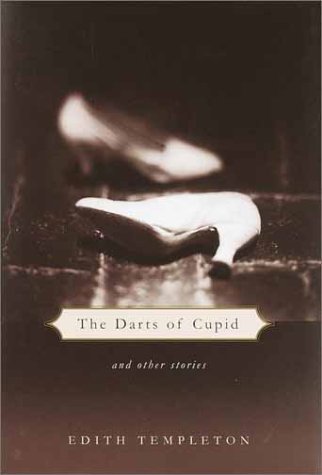
In The Darts of Cupid, Edith Templeton, now eighty-five, gives us a sweeping and intimate exposé of her century, and of the lives of women caught in the historic and personal contingencies it engendered. The unforgettable title story was celebrated upon its original publication in The New Yorker for its explicit portrayal of the relationship between a young British woman and her American superior in a provincial war office during World War II—a love affair that lasted only two nights but changed the narrator’s life forever, and is still haunting today, more than thirty years after the story was written. Other pieces take us from the tumbledown glamour of a Bohemian castle between the first and second world wars to an apartment on the coast of Italy in the 1990s, where a rich widow’s decision to sell her husband’s prized silver becomes a bewitching tale of menopausal longing.
In classic prose, Templeton delivers a lost world in all its heartbreaking detail—a continental way of life that matters more to us now that it has been all but erased by the turn of a troubled new century. Finally, this book is the record of a unique sensibility: whatever the period, Templeton addresses the truth about female passion with a forthright gaze that is entirely up to date.
About the Author
Edith Templeton was born in Prague in 1916, a subject of the Emporer Franz Josef. The child of estate-owners on both sides, she spent much of her childhood in a castle in the Bohemian countryside. As a girl, she knew both parents of President Havel, and had cousins who were part of Kafka’s circle in Prague. She courted scandal from an early age with her writing. When she was fourteen, an essay she had published in a student paper created a problem for the government and caused her to be excluded from all further education by the Republic: in the midst of a coal strike, she wrote how well-heated her private school was. She was forced to finish her education at a French Lycee, and left Prague society in 1938 to marry an Englishman. During her years in Britain, she worked in the Office of the Chief Surgeon for the U.S. Army in Cheltenham, and then became a Captain in the British Army, working as a high-level conference interpreter. After the war, divorced from her husband, she lived in a London garret and tried to make a go of it as a writer. Her short stories began to appear in The New Yorker in the fifties, and over the next several decades she published a number of novels, as well as a popular travel book, The Surprise of Cremona, in the U.K. Under a pseudonym, she also wrote Gordon, a novel banned for indecency in Germany and England; it was subsequently pirated by Girodias and sold in more than a dozen languages around the world. (She has only now agreed to republish this work under her own name.) “The Darts of Cupid,” a novella-length story set in England during the Second World War, was published in The New Yorker in 1968, and made history with the magazine’s readership because of its, for the time, explicit portrayal of a single night of love between a young married woman and her American superior in a U.S. War Office.
Mrs. Templeton’s second husband was Dr. Edmund Ronald, a celebrated cardiologist, who became the physician to the King of Nepal; he was the first European to enter the royal palace of that country. With Dr. Ronald, Templeton left England to live in India, where she met Nehru and the Dalai Lama, among other major figures. She now lives in Bordighera, on the coast of Italy.
"About this title" may belong to another edition of this title.