Synopsis
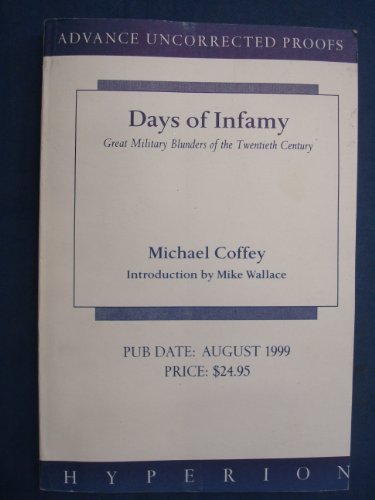
A fascinating look behind more than fifty of the most historic military blunders of our century. Lively and engaging, in-depth and informative, this companion to an upcoming series on the History Channel goes beyond mere footage to delve into the facts of some well-remembered but little understood incidents and accidents of modern military history.
Reviews
From the chauffeur's wrong turn that helped start WWI to the (unexploded) nuclear bomb that the United States Air Force once dropped over Spain, this engaging set of brief cautionary essaysAa companion volume to a History Channel seriesApresents some important and some amusing errors of wartime (and Cold War-time) judgment and execution. Coffey (The Irish in America), managing editor of PW, covers about two score blunders, in chronological order. The earliest concerns that swerving chauffeur (who accidentally brought Archduke Ferdinand face-to-face with his assassin); the latest is Saddam Hussein's invasion of Kuwait. About half the others concern WWII. Lost Luftwaffe pilots in 1940, though instructed to hit only military targets, panicked and let bombs go over London: thus did the blitz unintentionally begin. Later, in the Pacific theater, British "naval commanders blundered by underestimating air power's threat to major warships," and hence lost the Malaya peninsula, Singapore and two important battleships. Coffey's set of snafus and misjudgments extends, quite deliberately, from the nearly comic to the truly awful: some killed a few people and embarrassed top brass, while others (such as the Japanese loss at Midway) arguably changed the course of world events. A few of the errors (e.g., the Battle of Stalingrad) are staples of most textbooks. Others are less familiar, and less horrific than ironic: when the Allies decided to bomb the 1500-year-old Abbey of Monte Cassino in Italy, they created precisely the shelter for German troops they intended to destroy. (The devout local German commander would not install his troops in an intact monastery, but had no qualms about occupying its ruins.) Like the best general history volumes, Coffey's book, in clean, muscular prose, expertly informs as it artfully entertains. (Aug.) FYI: The History Channel's Great Military Blunders of the Twentieth Century begins its 26-week run in August.
Copyright 1999 Reed Business Information, Inc.
A fun albeit shallow look by Coffey, managing editor of Publishers Weekly and editor of The Irish in America (not reviewed)the companion volume to an upcoming History Channel seriesand with a lengthy and rewarding introduction by 60 Minutes Mike Wallace. Arranged chronologically within each war, Days of Infamy covers the greatest hits of military history in this century. There is nothing here that will come as a surprise to even a casual reader of modern history, but the accounts are written in light and casual style, with the facts always straight and clear, that makes the book an ideal occasional read. Coffey's definition of a military blunder seems to include any event that has happened during wartime, such as the Treaty of Versailles (more a diplomatic blunder than a military one) or the WWII bombing mission lost due to poor weather, but many of the tales certainly do fall into the genuine military blunder category, such as WWI's infamous Gallippoli (in which British and Australian troops were sent to attack a heavily defended Turkish beach); the story of the ``Bridge Too Far'' at Arnhem in WWII, in which the allies underestimated German capabilities in attempting to bring the war in Europe to a swift end; John F. Kennedy's Bay of Pigs disaster; the US bomber crash that brought four H-bombs plummeting onto Spain; and Jimmy Carter's attempt to free the hostages in Iran with a complicated military mission. Coffey is at his best when covering the large sweep of history in brief spurts, such as his introductions to the various sections into which the book is divided by historical periods. Brief, well-researched, and ultimately unenlightening, on a topic that involves the deaths of millions and could go on for volumes. (16 pages b&w photos) -- Copyright ©1999, Kirkus Associates, LP. All rights reserved.
As the literary companion to the History Channel documentary series, this book is a superficial, erroneous, and somewhat revisionist view of a haphazard collection of nearly 50 historical events in the 20th century. Although the selections are characterized as military blunders, many are purely political miscalculations, like the assassination of Archduke Ferdinand (1914), the Treaty of Versailles (1919), the Yalta Conference (1945), and the abortive Gorbachev coup (1989). Several other events mentioned in the book, while military in nature, had no military significance and therefore cannot be considered "great." The two world wars receive the most coverage, with short chapters on the battles of Gallipoli, Jutland, Stalingrad, and Midway, while the entire Korean War gets just four pages, and U.S. involvement in Vietnam is virtually dismissed with one page. Most glaring, however, is the absence of truly significant military blunders that are not mentioned at all, such as the disastrous Battle of the Somme, the fall of Singapore, and the chaotic Suez Operation in 1956. The book offers no conclusions and no narrative to compare or analyze the nature and dynamics of military (or political) blunders in an overall historical perspective. With little depth and no new scholarship, this is not an essential purchase.ACol. William D. Bushnell, USMC (ret.), Brunswick, ME
Copyright 1999 Reed Business Information, Inc.
A collection of snafus that range from the trivial to the strategic, Coffey's work fleshes out scripts for a History Channel series debuting this month. The incidents covered by the series roam among the century's well-known military-related screwups, from a driver's poor knowledge of Sarajevo's streets in 1914, giving us World War I, to Iraq's invasion of Kuwait. Thus constrained by the choices of the TV producers, which were presumably made pursuant to available film footage, Coffey relates incidents that have no thematic direction and no overarching interpretation. A cherry-picking impression results, which at least underscores the unexpected ways things go technically wrong on the battlefield, either from the design of a weapon (British battle cruisers at Jutland), friendly fire (Coffey chooses a U.S. bombing of U.S. troops in Normandy), or complacency (the sinking of the USS Indianapolis). Tossing in tactical mistakes like the German Blitz against British cities, Coffey retells stories that entertain the military history audience but which are superficial as history. Gilbert Taylor
"About this title" may belong to another edition of this title.