Synopsis
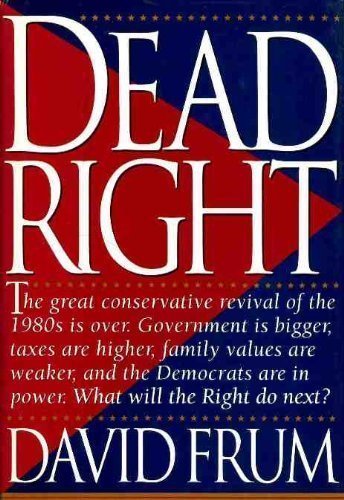
A Forbes columnist discusses the ideological breakdown of the Republican Party, its failure to diminish the deficit or the size of government in twelve years of control, and outlines a plan for renewal through a return to basic issues.
Reviews
A young tory's unsparing critique of political conservatism in the US and the divisive shambles its putative partisans have made of their cause. In his morning-after analysis, the Canadian-born Frum (a sometime Forbes columnist who now writes for The Financial Post) casts a cold eye on the 12-year span during which Republicans tenanted the White House. During the 1980s, he asserts, the increasing incidence of drug abuse, ethnic balkanization, family breakdown, and allied ills tempted some conservatives to cultivate new constituencies while others cursed the dark. By the time the Bush administration had petered out, he concludes, Reagan's bedrock supporters had split into three mutually contemptuous factions: optimists like Jack Kemp, who believe they can steer the ship of the welfare state on a rightward course; moralists like William Bennett, the former secretary of education; and isolationist nationalists, of whom Pat Buchanan is the ranking exemplar. Having done with internecine warfare, Frum goes on to dispute the notion that the so-called religious right poses a threat to the body politic, let alone to the secular left. As a practical matter, he argues, fundamentalists view their deity in much the same way as Great Society liberals thought of government: ``a distant benevolent agency that showers goodies upon all who ask, without demanding anything much in return--except for the occasional campaign contribution.'' Looking ahead to 1996 and beyond, the author sees little future for the conservatives unless (probably at the cost of immediate electoral gain) they return to their ideological roots, which stress minimal government intervention, individual freedom, self-reliance, personal probity, fiscal responsibility, and actual (rather than rhetorical) cuts in federal spending. A clear guide to the current fault lines in American conservatism by an author who laments that the conservative revival has stalled. -- Copyright ©1994, Kirkus Associates, LP. All rights reserved.
Conservative politicians are putting out books explaining the crack-up of their cause. Frum differs from the pack--represented by Quayle's Standing Firm (see Upfront, this issue) and Charles Kolb's White House Daze --in his attention to ideas over anecdotes, analysis over day-to-day electioneering. An alumnus of the high-profile proving ground for conservative writers, the Wall Street Journal's editorial page, Frum delivers a cogent retrospective of the Republican Party's interlude of influence (1981-87) as a means of handicapping its potential presidential field for 1996. He holds grave doubts about the ebullient Kemp, the censorious Bennett, and the nationalist Buchanan. Critical of the welfare state and skeptical of the party's repute as the opponent of bloated government, he argues, instead, that Republicans are as beholden to certain of Big Government's clients--farmers, small businesspeople, and veterans--as are Democrats to any of their special interests. In other areas, such as in its wary handling of the so-called religious right, Frum sees a party even further astray from conservatism. His essay is meant to agitate the ranks and, perhaps, leave them behind. A lively autopsy of an agonizing reappraisal. Gilbert Taylor
Why did the hoped-for new Republican majority never materialize despite the party's electoral success in the 1980s? Drawing on interviews with party leaders, pollsters, direct mail specialists, and journalists, Forbes columnist Frum paints a picture of a party that forgot its historic conservative message in order to position itself in the middle of the American political road. Noting that the government grew apace under Reagan and Bush despite rhetoric to the contrary, Frum takes Reagan to task for letting entitlements get out of hand and criticizes Bush's federal aid programs as more big government. Frum contends that the GOP's job is to reduce federal bureaucracy to the minimum size feasible under present political conditions. Aiming at that goal will spell success for the party. Philosophically deep and politically cogent, this is recommended for academic and larger political science collections.
Frank Kessler, Missouri Western State Coll., St. Joseph
Copyright 1994 Reed Business Information, Inc.
"About this title" may belong to another edition of this title.