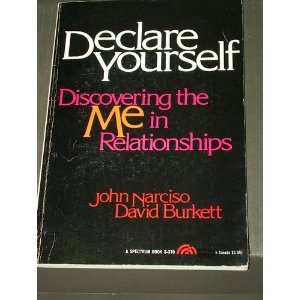
This book about communicating, personal responsibility, freedom and self-management in interpersonal relationships is a revised and retitled edition of the book published by Prentice-Hall from 1975 to 1991 in sixteen printings under the title Declare Yourself. It challenges many currently held psychological and philosophical concepts. Among the issues raised:
Are people really as helpless as many helpers want them to believe?
Are all those inadequate behaviors really illnesses to be treated and then paid for by medical insurance? Isn't it interesting that only the gamblers who lose seem to be the ones diagnosed as ill?
Is there any personal behavior that can't be characterized as having been caused by something outside ourselves? Perhaps, sometimes, it is our fault!
Should we try behaviors rather than motives in the courtroom, and only then consider circumstances?
How much personal responsibility can individuals be relieved of before the concept of "a nation of laws" crumbles?
What are the myths of feelings? How are feelings used to control others?
What is the alternative to being responsible for other's feelings?
While becoming as one in a relationship seems universally desired, isn't the perennial question still-which one?
How do people get their way with others?
Is our behavior pushed (motive) or pulled (purpose)? It does make a significant difference in how we see and react to the world.
This little book about people challenges the reader to consider alternative ways to view him/herself in the realm of interpersonal relationships. There is a little theory and a great deal of practical illustration.