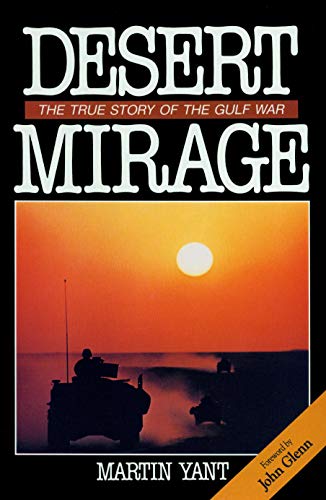
Synopsis
Shortly after Iraq invaded Kuwait on August 2, 1990, author Martin Yant argued in a newspaper column that Saddam Hussein's "military machine" wasn't nearly the menace President Bush said it was. Rather than being a well-equipped and "battle-hardened" million-man Wehrmacht at the command of another Adolf Hitler, Yant suggested that the Iraqi army appeared to be a "war weary," smaller, supply-short force at the command of another Manuel Noriega.
When the Persian Gulf War ended in February of 1991 in the U.S. led coalition's rout of the Iraqi army, Yant set out to write Desert Mirage to show how the Bush administration had deliberately deceived Americans into supporting the pursuit of power disguised as the pursuit of principle - at the cost of an estimated 375,000 lives.
In the process, Yant shows how the "liberation" of Kuwait, whose occupation the Bush administration helped cause - either by ineptness or design - was merely a pretense for assertion of American power in the Middle East.
Yant pieces together his convincing case from thousands of reports from dozens of sources that sporadically seeped through the administration's veil of deceit to reveal that the thunderously triumphant 'Desert Storm' was actually a deviously devised 'Desert Mirage' with far more foreboding causes and consequences than what the public could ever imagine.
Reviews
Columbus, Ohio, journalist Yant offers a carefully documented, scathing indictment of the Persian Gulf War as a ``war of deception'' amounting to outright fraud by US leaders. Yant has combed the mainstream press and some sources outside it to gather disturbing evidence about this highly groomed war in which ``media manipulation and censorship took [on] new and sinister forms.'' But even though much of the evidence is published elsewhere, Yant pieces it together into a lucid whole. Kuwait, the author finds, deliberately provoked Iraq by raising oil prices and pumping disputed oil, and Saudi Arabia encouraged the Iraqis to assume an aggressive stance against Kuwait. Yant reviews ambiguous moves by the US (including Ambassador Glaspie's assurance to Hussein that the US had ``no opinion on Arab-Arab border conflicts''). Satellite photos taken after the invasion suggest that Iraq was not menacing Saudi Arabia; Bush, Yant says, ``deliberately overstated [Iraq's nuclear bomb capability] after surveys showed the issue could positively affect public opinion.'' The author looks at how the military pool-reporting system resulted in the news media being ``first misled, then intimidated, and finally co-opted.'' Especially chilling is a discussion of whether Iraqi troops ``withdrew'' or ``retreated,'' a distinction that the coalition (saying the troops were under retreat) used to justify the strafing and carpet-bombing that killed untold numbers of Iraqis (buried uncounted in mass graves). Overall, Yant argues that the US wanted military intervention from the beginning and hid the success of the blockade and the viability of several peace initiatives to get its way. In the best tradition of contrarian investigative journalism, and worth consideration. (Four-page photo insert--not seen.) -- Copyright ©1991, Kirkus Associates, LP. All rights reserved.
YA-- In straightforward terms, Yant details the carefully orchestrated public-relations efforts that went into the war and ends with a strong hint that Pentagon censorship withheld information about the impact of the war on the American public and that the administration deliberately obscured significant events and issues through its strict control of the news media. The author charges that Washington ``practically encouraged Saddam Hussein to take over Kuwait'' and undermined plans for an Arab summit aimed at resolving the dispute between Iraq and Kuwait. He also points out that the embargo against Iraq was more effective than our government led us to believe. --Mike Printz, Topeka West High School, KS
Copyright 1992 Reed Business Information, Inc.
This sprawling, unfocused look at the Persian Gulf conflict generally tells us what we already suspect--that Pentagon censorship limited the impact of the war on the American public, sanitizing the slaughter by means of carefully orchestrated briefings while President Bush painted the affair as a noble battle for freedom against aggression. According to Yant ( Presumed Guilty ) the administration deliberately obscured significant events and issues through its strict control of the news media. Among the deceptions: the likelihood that the U.S., by accident or design, helped create the crisis (Washington, charges the author, "practically encouraged Saddam Hussein to take over Kuwait") and may have sabotaged an Arab summit aimed at resolving the dispute between Iraq and Kuwait. Other points weakly made: that the international embargo against Iraq was more effective than our government led its citizens to believe, and that the tactical performance of the so-called smart bombs as well as the Patriot missiles were disappointing, despite publicity to the contrary. Photos.
Copyright 1991 Reed Business Information, Inc.
Yant, the author of Presumed Guilty: When Innocent People Are Wrongly Convicted ( LJ 3/15/91), boldly goes where no journalist has taken us before in assessing the war for Kuwait. With clarity and passion, Yant describes the carefully orchestrated public relations efforts that went into the short war and concludes that the United States may be falling into an Orwellian world where information is controlled and freedoms dispensed. He notes that historians will surely debate for decades whether the main U.S. objective was to reassert Washington's global role in addition to controlling the Persian Gulf's vital oil resources. What is even less clear is whether the United States launched its anti-Iraq campaign to destroy the only power (a relatively wealthy, well-educated, and industrialized population) of the Arab world. Nevertheless, the war resulted in a crippling of Baghdad. For Yant, the implications of this outcome for the region and the world are daunting. A must read for those concerned with future U.S. military entanglements.
- Joseph A. Kechichian, Rand Corp., Santa Monica, Cal.
Copyright 1991 Reed Business Information, Inc.
"About this title" may belong to another edition of this title.