
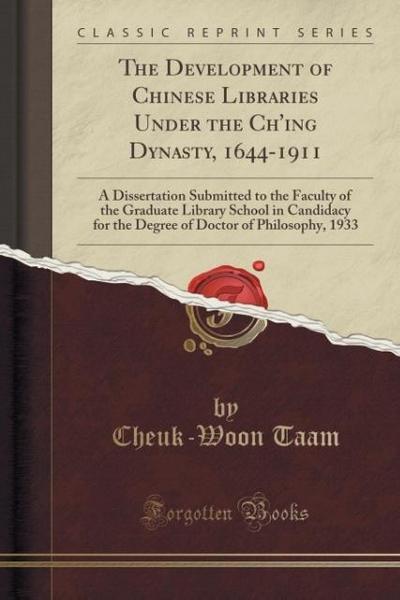
The Development of Chinese Libraries Under the Ch'ing Dynasty, 1644-1911 : A Dissertation Submitted to the Faculty of the Graduate Library School in Candidacy for the Degree of Doctor of Philosophy, 1933 (Classic Reprint)
Cheuk-Woon Taam
ISBN 10:
1334167605 ISBN 13:
9781334167607
Published by Forgotten Books Aug 2018, 2018
Language: English
Condition: New
Soft cover
Sold by AHA-BUCH GmbH, Einbeck, Germany
AbeBooks Seller since August 14, 2006
Seller rating 5 out of 5 stars

New - Soft cover
Condition: New
Price:
US$ 32.01
US$ 71.09 shipping
Ships from Germany to U.S.A.
Ships from Germany to U.S.A.
Quantity: 2 available
Add to basket


