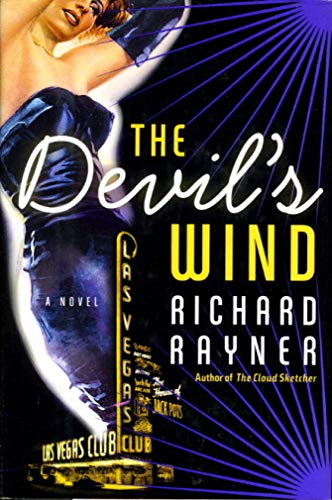
Working as an architect during the growth boom of McCarthy-era Las Vegas, Maurice Valentine is seduced by the beautiful Mallory Walker and fears that she may be using him to get close to a powerful mobster, a situation for which Valentine finds himself rendered a pawn in a mysterious game of revenge. By the author of The Cloud Sketcher.
Rayner, an English-raised author who lives in Southern California, has written a Hollywood noir for his sixth book. Filled with money and power, lust and revenge,
Devil’s Wind resembles the dark crime fiction of Raymond Chandler, Dashiell Hammett, James Ellroy, and Elmore Leonard. It also has a taste of Fitzgerald’s
Great Gatsby, as everyone’s reinvented themselves a few times over. Rayner’s set pieces and characters-from his casino hotels and Las Vegas parties celebrating A-bomb tests to his gangsters-turned-tycoons, African-American jazz musicians, and cameos by Frank Sinatra and Jimmy Hoffa-evoke the glossy sheen covering the era’s massive social corruption. Only the novel’s plotting, while ingenious, generated some confusion. Still,
Devil’s Wind is a fine addition to its genre.
Copyright © 2004 Phillips & Nelson Media, Inc.
Smooth, callow architect Maurice Valentine scores a calculated marriage to a wealthy senator's daughter, casually names names for Joe McCarthy, designs casino hotels and builds mock suburban subdivisions to be vaporized by atomic testing. But when cool, blonde femme fatale Mallory Walker appears, noir strictures demand that the moral house of cards that is this cynical operator's life be slated for demolition. They also require a thrillingly lurid plot machinery—including a troubled mob patriarch and son, a land scam involving Jimmy Hoffa, heroin, murder, revenge and periodic nuclear blasts—to embroider an elemental struggle pitting 1956 Las Vegas, aka corruption and hollowness, against insurgent beatnik romance. Rayner (
The Cloud Sketcher) mines such Nevada gothic sources as
The Godfather Part II and
Bugsy for inspiration, and he handles his classic pulp materials with style. The novel's tacit theme—why the '50s deserved to be annihilated by the '60s—is conveyed by reiteration of Nietzschean truisms ("[E]verybody wants power.... Power, not goodwill, not democracy, not love," muses Maurice, while Mallory opines, "God quit a long time ago") that combine jaded worldliness with apocalyptic anticipation. Plot twists and betrayals, bomb blasts and unrequited love all add up to a classy neo-noir.
Copyright © Reed Business Information, a division of Reed Elsevier Inc. All rights reserved.
Las Vegas is hot--no, not today's Disneyized version of the city but the 1950s incarnation, where Dean drank, Sammy pranced, Frank ruled, and the Mob profited. Rayner skillfully mixes aspects of Vegas history--the city's first integrated casino (the Moulin Rouge, called Gai Moulin here), the unsolved murder of black sax player Wardell Gray (Wardell Lane here), and the nuclear tests conducted in the Nevada desert--and mixes them with his own plot: an ambitious architect with a hidden identity running up against a femme fatale with hidden identities of her own (think Kim Novak in
Vertigo). The real-life themes have been covered elsewhere--Bill Moody's
Death of a Tenor Man (1995) tackled the Gray murder, and Charles Fleming's
Ivory Coast (2002) set its action in the groundbreaking casino--but Rayner stirs the pot his own way, building believable characters and turning them loose against a recognizable but still swinging backbeat. Throw in a couple of mushroom clouds, and you have a novel with plenty of bang and more than a little heart.
Bill OttCopyright © American Library Association. All rights reserved