Synopsis
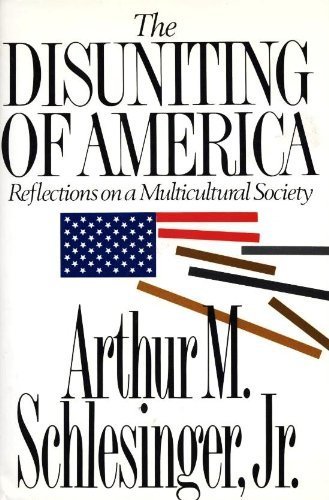
The Pulitzer Prize-winning historian examines the changing face of American history, demonstrating how an increasing focus on ethnicity has affected life in academic circles and on the street.
Reviews
In a courageous, important, forcefully argued essay, Pulitzer Prize-winning historian Schlesinger contends that America as melting pot has given way to an "eruption of ethnicity" that threatens to replace assimilation with fragmentation, and integration with separatism. As a case in point, he critiques Afrocentric curricula in schools and colleges which, in his view, glorify a mythic past and make such highly dubious claims as the notion that black Africa is the birthplace of science, philosophy, religion and technology, and the trendy but totally unsubstantiated theory that ancient Egypt was essentially a black African country. Those who attempt to use the schools for "social and psychological therapy" to promote minority self-esteem are doomed to failure, asserts Schlesinger, because "feel-good history" is factually flawed and does not equip students to grapple with their lives. Schools should certainly teach about other cultures and continents, he stresses, while faulting multiculturalists who forget that Europe is the unique source of liberating ideas of individual autonomy, political democracy and cultural freedom to which most of the world today aspires. The book was originally published in 1991 by Whittle Communications for selective distribution.
Copyright 1991 Reed Business Information, Inc.
A passionate criticism of multiculturalism by the two-time
Pulitzer-winner.
Schlesinger, a lifelong advocate of human rights, believes
that this ``eruption of ethnicity'' has had many good
consequences, that the belated recognition of the pluralistic
character of American society has had a bracing impact on the
teaching and writing of history, and that nothing is more natural
than for black Americans to assert pride and claim identity. But
cultural pluralism is not the issue, he says--``the issue is the
teaching of bad history under whatever ethnic banner.'' When
Oregon students learn that Africans visited the Americas before
Columbus, or that Pythagoras and Aristotle stole their
mathematics and philosophy from black scholars in Egypt, it is
not only wrong, the author says, but it is the use of history as
therapy. When black educators argue that black minds work in
genetically distinctive ways, it is ``just another word for
racism.'' The Ku Klux Klan, says Schlesinger, could not devise a
curriculum more effective in handicapping and disabling black
Americans. Moreover, the author sees the multiculturalism
movement as attacking the very fundamentals of American
democracy, finding that its underlying philosophy is that
``America is not a nation of individuals at all but a nation of
groups, that ethnicity is the defining experience for most
Americans.'' Schlesinger is blunt in his rebuttal: ``It may be
too bad that dead white European males have played so large a
role in shaping our culture. But that is the way it is.''
A refreshing, outspoken treatment of a phenomenon too often
clothed in euphemism. -- Copyright ©1991, Kirkus Associates, LP. All rights reserved.
"About this title" may belong to another edition of this title.