Synopsis
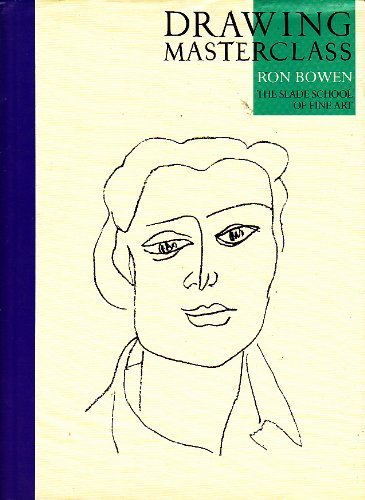
This unique book invites you to study and learn the art of drawing as a student of Ron Bowen's Drawing Masterclass. An animated and informative discussion of drawing - its masters and masterpieces, basic techniques and innovative methods - this volume is, most important, a series of lessons with the aim of allowing each one of us to discover and utilize our innate ability to draw. Drawing Masterclass will take its place as a classic work of art instruction, theory, and history, teaching its readers to draw by revealing the many and varied levels at which drawing works.
Ron Bowen believes that everyone can draw. The difficulties in drawing arise not from a lack of technique or coordination, but rather from untrained perception, an inability to "see" as the art requires. For this volume, Bowen re-creates the approach he uses in his classes at The Slade School of Fine Art: guiding by example rather than dictating a method, revealing possibilities and options rather than circumscribing technique and style.
Drawing Masterclass draws on and explains the work of scientists, linguists, philosophers, and psychologists but never loses sight of the magic of drawing and how to create it yourself. Each chapter centers on one element of drawing and builds to a "game" in which the reader participates in visual experiments that grow incrementally in complexity - from drawing an object or your own face, to constructing a space, changing light sources, elaborating and reducing form, and using methods of measurement and perspective. Each game is a step toward discovering the skill to draw freely, spontaneously, and effectively.
Drawing Masterclass contains many of the world's greatest and most interesting drawings. Here are works not only by the finest artists such as Leonardo da Vinci, Durer, Rembrandt, Picasso, Matisse, and O'Keeffe, but also drawing in its more popular form - images of Spider-Man, a tattooed woman, and sketches made by the Russian filmmaker Sergei Eisenstein. Each drawing is relevant to the text, revealing the full range of drawing technique and method, illustrating Bowen's lessons about line, tone, light, size, distance, movement, and space, as well as providing an excellent historical overview of fine drawing.
Paper, a pencil, a mirror, and an open mind are the only tools you need to follow this practical and challenging guide.
Reviews
Both of these books stress the importance of seeing properly and, moreover, the use of all senses while drawing--emphasizing that the student should draw what interests and inspires. But Bowen writes for those with an understanding of Fine Art principles--e.g., spacial relations, perspective, the relationship of line and form--as well as a working familiarity with psychology, sociology, and history. He demands that the new artist have an open mind and be receptive to a wide variety of subject matter, whether abstract, minimal, or homophilic. To develop the student's personal expression, Bowen offers mental games and drawings from great masters as encouragement. Albert leads the novice through specific exercises, citing the materials to be used, the objective, and the approximate time needed to complete the exercise. His positive, cheerleading approach will appeal to a wider variety of the artistic public, making the work suitable for all collections. The often subtle relationship between the illustrations and the lessons in Bowen's book, as well as his scholastic language, make Drawing Masterclass more suitable for an academic audience.
- Jacqueline Garlesky, Univ. of Pittsburgh, Johnstown, Pa.
Copyright 1993 Reed Business Information, Inc.
"About this title" may belong to another edition of this title.