Synopsis
Object Lessons is a series of short, beautifully designed books about the hidden lives of ordinary things.
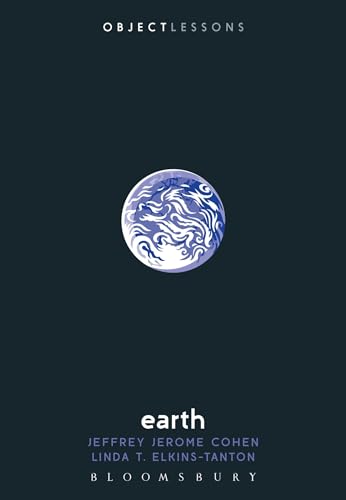
In Earth, a planetary scientist and a literary humanist explore what happens when we think of the Earth as an object viewable from space. As a “blue marble,” “a blue pale dot,” or, as Chaucer described it, “this litel spot of erthe,” the solitary orb is a challenge to scale and to human self-importance. Beautiful and self-contained, the Earth turns out to be far less knowable than it at first appears: its vast interior an inferno of incandescent and yet solid rock and a reservoir of water vaster than the ocean, a world within the world. Viewing the Earth from space invites a dive into the abyss of scale: how can humans apprehend the distances, the temperatures, and the time scale on which planets are born, evolve, and die?
Object Lessons is published in partnership with an essay series in The Atlantic.
About the Authors
Jeffrey Jerone Cohen is Dean of Humanities at Arizona State University, USA, and co-president of the Association for the Study of Literature and the Environment. He is the author or editor of 13 books, including Stone: An Ecology of the Inhuman (which received the 2017 René Wellek Prize for best book in comparative literature) and in collaboration with Lindy Elkins-Tanton, Earth (Bloomsbury, 2017), a re-examination of planet from the perspectives of a planetary scientist and a literary humanist.
Linda T. Elkins-Tanton is a planetary scientist, and the Principal Investigator of the NASA Psyche mission. She is the Director of the Space Sciences Laboratory at the University of California, Berkeley. Previously, she was Vice President at Arizona State University, Director of the Department of Terrestrial Magnetism at the Carnegie Institution for Science, and faculty at MIT. She is the author of The Solar System, a six-book series, published by Chelsea House, 1st edition 2006; 2nd edition 2010: The Sun, Mercury, and Venus, The Earth and the Moon, Mars, Asteroids, Meteorites, and Comets, Jupiter and Saturn, Uranus, Neptune, Pluto, and the Outer Solar System. She is co-editor, with A. Schmidt and K. Fristad, of Volcanism and Global Environmental Change (Cambridge University Press, 2015). Her articles have been published in Philosophical Transactions of the Royal Society, Nature Geoscience, Nature, Annual Review of Earth and Planetary Sciences, and Astrophysical Journal, among other publications.
Ian Bogost is an author and an award-winning game designer. He is Barbara and David Thomas Distinguished Professor in Arts & Sciences, Director of Film & Media Studies, and Professor of Computer Science and Engineering at Washington University in St. Louis. Bogost is also Founding Partner at Persuasive Games LLC, an independent game studio, and a Contributing Editor at The Atlantic. Bogost is author or co-author of ten books, including Alien Phenomenology (2012)and Play Anything (2016).
Christopher Schaberg is Director of the Program in Public Scholarship at Washington University in St. Louis, USA, and the author of The Textual Life of Airports (2012), The End of Airports (2015), Airportness (2017), The Work of Literature in an Age of Post-Truth (2018), Searching for the Anthropocene (2019), Pedagogy of the Depressed (2021), and Adventure: An Argument for Limits (2023), all published by Bloomsbury. He is also the founding co-editor (with Ian Bogost) of Bloomsbury's Object Lessons book series.
"About this title" may belong to another edition of this title.