Most newspapers and magazines issue their contributors with a style guide. Writers, be they on staff or freelance, then know whether a publication's house style requires % or per cent or commas in dates. Sometimes it's just a tatty sheet of typed A4 but since 1986
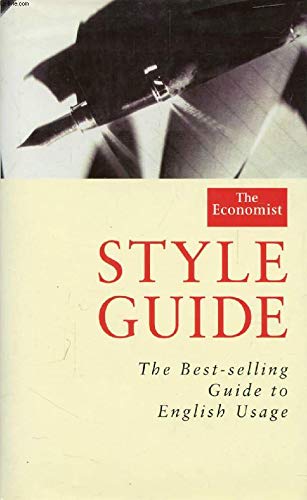
The Economist has developed its stylish Style Guide, through six editions, into a full length reference book.
Because English is such a vast and continuously evolving language--its vocabulary is double that of French and more than three times larger than German--it is open to multifarious use and all the old arguments about correctness or lack of it. The Economist unequivocally sets out its version of what is acceptable and why, usually conforming to Fowler's Modern English Usage and other good guides to getting it right. It also refutes dozens of common errors, stating firmly, for example, that "Data are plural" and that "Any one refers to a number; anyone to anybody."
Since its style guide is set out in such detail, it makes sense to publish it for the rest of the world, most of whom are not writers for The Economist but who simply want a succinctly witty guide to writing accurately. The first section focuses on minutiae such as distinguishing between a "little-used car" and a "little used-car". It also insists that "to never split an infinitive is quite easy" and, in English so impeccable that you have to read it twice to be sure, that "Frankenstein was not a monster, but his creator." After a section setting out rules governing American and British English this handy reference book provides a miscellany of useful information including abbreviations, currencies, calendars and conversions for metric and imperial measurements. --Susan Elkin
Rare is the style guide that a person--even a word person--would want to read cover to cover. But
The Economist Style Guide, designed, as the book says, to promote good writing, is so witty and rigorous as to be irresistible. The book consists of three parts. The first is the
Economist's style book, which acts as a position paper of sorts in favor of clear, concise, correct usage. The big no-noes listed in the book's introduction are: "Do not be stuffy.... Do not be hectoring or arrogant.... Do not be too pleased with yourself.... Do not be too chatty.... Do not be too didactic.... [And] do not be sloppy." Before even getting to the letter
B, we are reminded that
aggravate "means
make worse, not
irritate or
annoy"; that an
alibi "is the proven fact of being elsewhere, not a false explanation"; and that
anarchy "means the
complete absence of law or government. It may be harmonious or chaotic."
Part 2 of the book describes many of the spelling, grammar, and usage differences between British and American English. While many Briticisms are familiar to most Americans and vice versa, there are some words--such as homely, bomb, and table--that take on quite different meanings altogether when they cross the Atlantic. And part 3 offers a handy reference to such information as common business abbreviations, accountancy ratios, the Beaufort Scale, commodity-trade classifications, currencies, laws, measures, and stock-market indices. The U.S. reader should be aware (but not scared off by the fact) that some of the style issues addressed are specifically British. --Jane Steinberg