
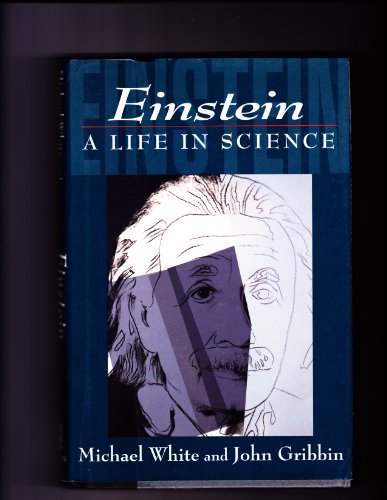
Einstein: A Life in Science
White, Michael J.,Gribbin, John
ISBN 10: 0525937501 ISBN 13: 9780525937500
Published by Dutton, 1994
Used
hardcover
From
Half Price Books Inc., Dallas, TX, U.S.A.
Seller rating 5 out of 5 stars

AbeBooks Seller since September 15, 2017
This specific item is no longer available.
About this Item
Description:
Connecting readers with great books since 1972! Used books may not include companion materials, and may have some shelf wear or limited writing. We ship orders daily and Customer Service is our top priority! Seller Inventory # S_463466071
Synopsis:
A biography of the archetypal scientist traces Einstein's monumental advances in thermodynamics and physics and offers a detailed appreciation of his profound influence on the direction of all subsequent scientific inquiry. 25,000 first printing.
Reviews:
The authors' second in a series of "life in science" biographies, after Stephen Hawking , is aimed more toward the general reader than the specialist; a slightly didactic tone even suggests a young adult audience. Although Gribbin and White do not avoid real physics, nor the corollary metaphysics that give their subject his iconic halo, their examination of Einstein's (1879-1955) life and career makes for considerably less rigorous reading than Abraham Pais's Subtle Is the Lord , which, published in 1982, is the most recent full Einstein biography. Purposefully directing themselves to examine the origins of Einstein's contributions ("If you want to know how often Einstein brushed his teeth, you will not find the answer in our book"), the authors have crafted a deft invitation to further reading.
Copyright 1994 Reed Business Information, Inc.
The same team that brought you Stephen Hawking: A life in Science has decided to defend Albert Einstein against assorted revisionist treatments. Principal among Einstein's critics are those who say Einstein's first wife, Mileva Maric, is not given credit for her contributions to special relativity theory and that, in general, she had a rough time. (Their illegitimate daughter was placed for adoption and subsequently lost to history; Einstein's mother loathed Mileva for her peasant origins, etc.) Since the authors find nothing good to say about her, quoting sources describing her as unattractive, distrustful, and noting that she never did get her degree, they can hardly be credited with unbiased views. On the other hand, they are prepared to say that Einstein himself may have suffered schizophrenia--following a notion of psychiatrist Anthony Storr that seems off the wall. Be that as it may, they do manage to bring off a colorful description of the life for which the adjective peripatetic hardly suffices. Poor Maleva and the later-born sons followed along, making do and making Poppa as comfortable as possible. The chapters interleave the life with popular accounts of the major work, underscoring the papers produced in 1905, the ``annus mirabilus,'' that launched Einstein's reputation. The paper on the photelectric effect earned Einstein the Nobel in 1922--proceeds of which he had agreed years before to give to Maleva after their divorce. In due course, we meet the physicists and astronomers who would later verify the accuracy of general relativity by measuring the bending of starlight near the sun during an eclipse. Following Einstein's rejection of quantum theory in the 1920's, the authors trace the personal eclipse of Einstein's creative career and ascent to the role of elder statesman and charming Princeton eccentric. Certainly some new and interesting details here, and accurate, acessible explanations of theory. But please, Einstein's life needs no apology! -- Copyright ©1994, Kirkus Associates, LP. All rights reserved.
The authors of Stephen Hawking: A Life in Science (1992) have again collaborated, this time to create a study of both the life and the scientific principles of the greatest modern thinker. Einstein's illumination of relativity and quantum theory is put in perspective not only with events in his life but also with the scientific sphere and political world he inhabited. The effects of the first and second world wars on his life and work are detailed, along with his apparently dichotomous evolution as a pacifist and a Zionist. The authors manage to dismiss many mysteries and myths while revealing new information, such as Einstein's FBI portfolio and possible schizophrenia. The result is a strong portrait of the personality and great achievements of a sublime individual. Denise Perry Donavin
This biography of Einstein, by the authors of Stephen Hawking: A Life in Science ( LJ 5/1/92), provides both an insightful and well-balanced portrait of the man as well as clearly explained analyses of his scientific contributions. Well researched, it includes a reference to other works about Einstein, extensive notes, and a thorough index. The paradoxical or seemingly contradictory characteristics that Einstein embodies are objectively considered and placed in perspective. Likewise, given the technical credentials of the authors, Einstein's scientific output and its effect on the scientific community are thoroughly evaluated. An enjoyable and educational book to read.
- Hilary D. Burton, Lawrence Livermore National Lab., Livermore, Cal.
Copyright 1994 Reed Business Information, Inc.
"About this title" may belong to another edition of this title.
Bibliographic Details
Title: Einstein: A Life in Science
Publisher: Dutton
Publication Date: 1994
Binding: hardcover
Condition: Very Good