Synopsis
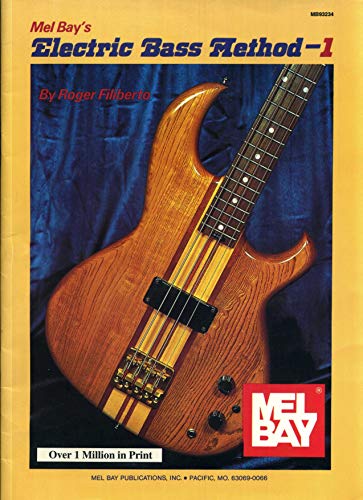
The most widely-used introductory bass method available! Both Volumes I and II present a standard notation approach to reading solo and arpeggio studies for four string bass. Included in Volume I are the rudiments of playing, plus handy charts of arpeggios featuring major, minor, augmented, diminished, and seventh chords, plus upper harmonic extensions. Volume II continues with studies, scales, walking bass patterns, and more. Applicable to any style of music, this method has gained acceptance as the foundational text for electric bass study world-wide.
About the Author
Roger Filiberto needs no introduction to the guitar world, as his students are some of the finest artists in America today. Roger started teaching tenor banjo in 1923. With his experience of playing in the Dixieland music era, he quickly became aware that the succession of chords C, E7, A7, D7, G7, back to C, followed by C7, F, Fm, and then ending with C, A7, D7, G7 to C would train almost any interested student to cope with the "faking" required of banjo players in that era. He taught this sequence of chords in all reasonable keys to all of his students. Beginning in the mid-1920's, Roger taught countless students to play banjo, steel guitar, Spanish guitar, and bass at his studio in New Orleans. After many years of teaching, he published his first book, the Melody Chord System for Spanish Guitar, with Forster in 1936. This publication was followed by a similar book for guitar, Chord Construction and Harmony as Applied to the Guitar, published by Gibson. The Gibson steel guitar book was later republished by Mel Bay Publications, Inc., with a comprehensive one-volume edition issued in 1968 under the title Complete Steel Guitar Method.
"About this title" may belong to another edition of this title.