Synopsis
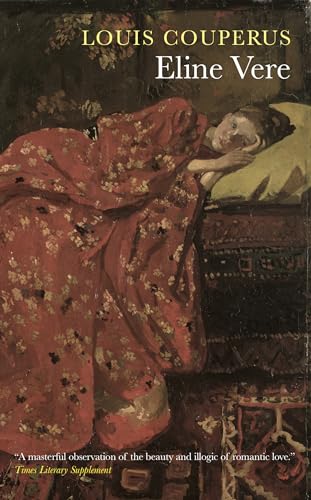
Eline Vere is a engrossing, brilliantly observed novel. Love, sorrow, madness and the tyranny of social snobbery are all laid bare in this classic of Dutch literature the book which made Louis Couperus, The Netherlands' answer to Oscar Wilde, famous.
In 1889, Dutch society was enthralled by Eline Vere , published in instalments in the newspaper, which minutely described the conventions, manners and hypocrisies of society with richness of description and vivid characterizations. Eline Vere and her sister Betsy are wealthy young socialites living in The Hague in the 19th century. Eline attempts to break free from the confines of her narrow existence through tumultuous and ultimately disastrous courtships. Eline is not merely a figure of her times but also a passionate spokesperson, too often foolish and futile. In her sensibility she is worthy of having one of the richest most satisfying novels of the late 19th century named after her.
'Couperus binds both irony and spiritual redemption. ' — The Daily Telegraph
'Couperus sympathy for the hybrid, the impure and the ambiguous gave him a peculiarly modern voice. It is extraordinary that this Dutch dandy, writing in the flowery language of fin-de-siecle decadence, should still sound so fresh.' — Ian Buruma, The New York Times Review of Books
Louis Couperus (1863–1923), regarded as one of the foremost figures in Dutch literature, was a leading member of the Tachtigers movement. Born in the Hague, Couperus was taken by his family to the Dutch East Indies as a child, where he remained until his father's death. His other novels include Eline Vere (1889), Ecstasy ( Extaze: Een boek van geluk , 1892), Inevitable ( Langs lijnen van geleidelijkheid , 1900), and The Hidden Force ( De Stille Kracht , 1900), all of which are available from Pushkin Press. A renowned wit, raconteur and commentator, Couperus continued to publish critically and commercially successful work until his death.
About the Author
Louis Couperus (1863–1923) spent much of his youth in the Dutch East Indies (now Indonesia), and many of his novels and stories are set either there or in The Hague, where he was born, though his work also contains glimpses of Italy, Africa, and China, where he traveled extensively. He gained prominence in 1889 with Eline Vere. His novels The Hidden Force, Old People and the Things That Pass, Ecstasy, and Inevitable are also celebrated. Couperus was the greatest Dutch novelist of his generation.
Ina Rilke translates Dutch, French, and Flemish literature. The writers she has translated include Hafid Bouazza, Hella Haasse, W. F. Hermans, Arthur Japin, Erwin Mortier, Cees Nooteboom, and Dai Sijie. She has won the Vondel Translation Prize, the Scott Moncrieff Prize, and the Flemish Culture Prize for Translation.
"About this title" may belong to another edition of this title.