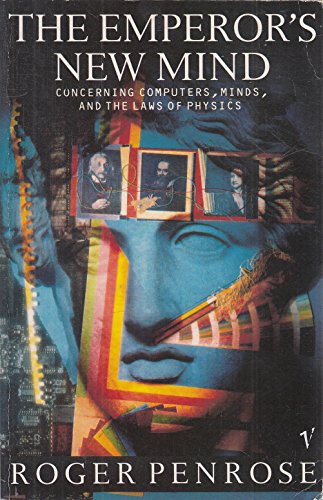
The proponents of artificial intelligence want to prove that it is only a matter of time before computers will be doing everything that a human mind can do. They take it for granted that pleasure and pain, the appreciation of beauty and humour, consciousness and free will are capacities that a computer will display once the appropriate programs of algorithms have been developed. Some disagree, because although electronic computers can calculate very rapidly, that does not make them understand what they are doing any more than, for example, an abacus does. The author puts forward his view that there is some facet of human thinking that can never be emulated by a machine. He shows the physical and mathematical ideas that are the background to his argument - from Turing machines, algorithms and the Chinese room, via quantum mechanics, cosmology and relativity to the structure of the brain, inspiration and consciousness itself.
Some love it, some hate it, but
The Emperor's New Mind, physicist Roger Penrose's 1989 treatise attacking the foundations of strong artificial intelligence, is crucial for anyone interested in the history of thinking about AI and consciousness. Part survey of modern physics, part exploration of the philosophy of mind, the book is not for casual readers--though it's not overly technical, it rarely pauses to let the reader catch a breath. The overview of relativity and quantum theory, written by a master, is priceless and uncontroversial. The exploration of consciousness and AI, though, is generally considered as resting on shakier ground.
Penrose claims that there is an intimate, perhaps unknowable relation between quantum effects and our thinking, and ultimately derives his anti-AI stance from his proposition that some, if not all, of our thinking is non-algorithmic. Of course, these days we believe that there are other avenues to AI than traditional algorithmic programming; while he has been accused of setting up straw robots to knock down, this accusation is unfair. Little was then known about the power of neural networks and behavior-based robotics to simulate (and, some would say, produce) intelligent problem-solving behavior. Whether these tools will lead to strong AI is ultimately a question of belief, not proof, and The Emperor's New Mind offers powerful arguments useful to believer and nonbeliever alike. --Rob Lightner