
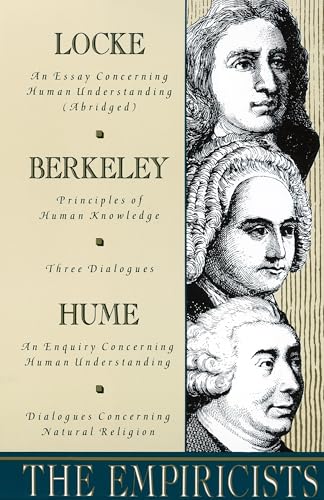
The Empiricists: Locke: Concerning Human Understanding; Berkeley: Principles of Human Knowledge & 3 Dialogues; Hume: Concerning Human Understanding & Concerning Natural Religion
Hume, David, Berkeley, George, Locke, John
ISBN 10: 0385096224 ISBN 13: 9780385096225
Published by Anchor, 1961
Used
Paperback
From
HPB-Diamond, Dallas, TX, U.S.A.
Seller rating 5 out of 5 stars

AbeBooks Seller since September 15, 2017
This specific item is no longer available.
About this Item
Description:
Connecting readers with great books since 1972! Used books may not include companion materials, and may have some shelf wear or limited writing. We ship orders daily and Customer Service is our top priority! Seller Inventory # S_459478812
Synopsis:
The rise and fall of British Empiricism is philosophy's most dramatic example of pushing premises to their logical--and fatal--conclusions. Born in 1690 with the appearance of Locke's Essay, Empiricism flourished as the reigning school until 1739 when Hume's Treatise strangled it with its own cinctures after a period of Berkeley's optimistic idealism. The Empiricists collects the key writings on this important philosophy, perfect for those interested in learning about this movement with just one book.
About the Author:
John Locke (1632-1704) was educated at Christ Church, Oxford and held various academic posts at that university, lecturing on Greek and rhetoric. An English philosopher and physician, he is widely regarded as one of the most influential of Enlightenment thinkers and commonly known as the "Father of Liberalism." He wrote also on theology, education, and in defence of religous tolerance, while founding the analytic philosophy of the mind.
David Hume (1711-1776) was a Scottish philosopher, historian, economist, and essayist, who is best known today for his highly influential system of radical philosophical empiricism, skepticism, and naturalism. As well as his Essays, which were republished and expanded throughout his life, he wrote A Treatise of Human Nature.
George Berkeley (1685-1753) was an Irish philosopher best known for the advancement of a theory he called "immaterialism." He wrote A Treatise Concerning the Principles of Human Knowledge in 1710.
"About this title" may belong to another edition of this title.
Bibliographic Details
Title: The Empiricists: Locke: Concerning Human ...
Publisher: Anchor
Publication Date: 1961
Binding: Paperback
Condition: Very Good