Synopsis
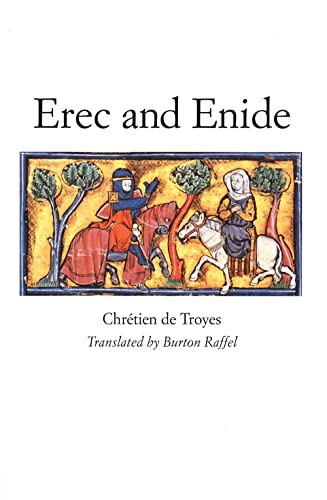
Erec and Enide the first of five surviving Arthurian romantic poems by twelfth-century French poet Chrétien de Troyes narrates a vivid chapter from the legend of King Arthur. Chrétien's romances became the source for Arthurian tradition and influenced countless other poets in England and on the Continent. Yet his swift-moving style is difficult to capture in translation and today's English-speaking audiences remain largely unfamiliar with the pleasures of reading his poems. Now an experienced translator of medieval verse who is himself a poet has translated Eric and Enide in an original three-stress metric verse form that fully captures the movement the sense and the spirit of the Old French original. Burton Raffel's rendition preserves the subtlety and charm of a poem that is in turn serious dramatic bawdy merry and satiric. Erec and Enide tells the story of Erec a knight at King Arthur's court whose retirement to domestic bliss with his beautiful new wife Enide takes him away from his chivalric duties. To regain his knightly honor Erec sets out with Enide on a series of amazing adventures. Eric dispatches thieves and giants with prodigious strength and valor but treats his wife rather harshly for doubting his abilities. When Enide is kidnapped by a robber baron Erec revives from near-death to perform a courageous rescue and at length the two are reconciled.
From the Inside Flap
"Ms. Gilbert's couplets read beautifully, encompassing Chrétien's range of tone—from wit to elevation of sentiment—very sensitively."—Charles Muscatine, author of Chaucer and the French Tradition
"A wonderfully accurate and witty translation of Chrétien's Erec and Enide which brilliantly renders the rhymed octosyllabics of the original text in compelling, colloquial English. . . . A treat not just for students and scholars of Old French literature but, more important, for what we now call general readers—that is, all those who relish a rollicking, well-told tale."—Sandra M. Gilbert, editor of The Norton Anthology of Literature by Women
"Older translations, generally in stupefying Maloryan prose, convey little of the sense of the poetry so obvious in the original, and admirably reproduced in this translation."—Robert Harrison, translator of Gallic Salt: Eighteen Fabliaux
"One of the best English verse renderings of any poem by Chrétien."—William J. Kibler, author of An Introduction to Old French
"A union of scholarship and consummate art that affected me like the great stories I read in my formative years; a permanent vicarious experience."—Ruth Stone, poet, author of Second-Hand Coat
"This will be a standard English translation of Erec and Enide and a definitive one."—Roger J. Steiner, editor of The New College French and English Dictionary
"About this title" may belong to another edition of this title.