Synopsis
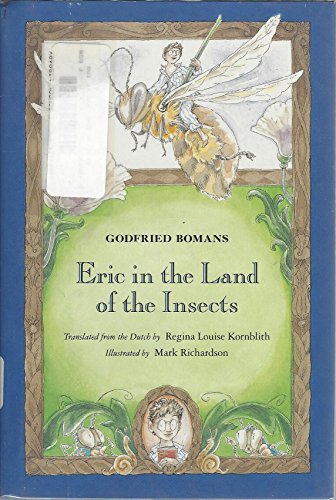
Nine-year-old Eric Pinksterblom enters the lush landscape painting on his bedroom wall and discovers a world of meadow insects, which is stunningly similar to the world of humans, and meets an array of insect characters.
Reviews
Grade 5-8-As Eric lies in bed one night contemplating the next day's quiz on insects, his gaze is drawn to a painting on the wall that depicts the tiny creatures at work. He muses aloud that he would like to live among insects, since then he would not have to take tests about them. His wish is overheard by the portraits of his grandparents, and his grandmother inexplicably grants it. He shrinks and jumps into the frame of Industrious Valley, where he encounters a host of beings whose thoughts and actions parody those of humans. At first this society fascinates Eric, and he gains celebrity status by constantly quoting his natural history book. But homesickness sets in, and he begins seeking a way out of the painting. He awakens in his own bed after taking part in a battle between two ant armies. This is a translation of a Dutch novel originally published in 1941. The premise is a little hard to swallow, and the formal style makes the story seem dated and smug. Eric's speeches suffer from the same problem; no modern boy sounds so prissy, nor would one blush with such frequency. Perhaps this fantasy would have appealed 50 years ago, but today it's a bit tiresome.
Mary Jo Drungil, Niles Public Library District, IL
Copyright 1994 Reed Business Information, Inc.
Originally published in the Netherlands more than 50 years ago, this newly translated fantasy appears in English for the first time. Eric, a third grader cramming for a test on insects, magically enters a painting that shows "every possible insect that one could think of." The wasps, bees, butterflies and others are satirically drawn as inhabitants of a kind of parallel world, allowing Bomans sly but essentially genial observations about class structure and snobberies. " 'We are always delighted to entertain a gentleman ,' a wasp said, in a tone that could be taken as a warning." The resolution gently pokes fun at Eric's own world when he does miserably on his insect test. A sturdy whimsicality prevails, with the tale fairly exuding an old-fashioned charm. Finely wrought black-and-white illustrations bolster the antique appeal. Ages 8-up.
Copyright 1994 Reed Business Information, Inc.
With a schoolboy's certainty that something wonderful is about to happen, Eric is only a little startled when the ancestral portraits in his bedroom become animated. Through these relatives, he learns that he can enter a picture of industrious insects, about which he is studying in school. Once bug-sized and inside the frame, Eric discovers a class system not unlike its human counterpart (nobility is important, as is the presence of a stinger). For his knowledge of Solm's Concise Natural History (a sort of Baedeker of the bug world), Eric is admired, envied, suspect; more than once he reminds the insects that they don't need his book information to perform their tasks, that their intuitive survival skills are perfect. Eccentric b&w line drawings reflect the novel's comic spirit, making Eric's size and adventure more real. As translated by Kornblith, the telling is sharply satirical; its occasional preciousness may be attributed to the fact that the book was first published in Holland in 1941. Modern sensibilities may be impatient to find that it was all, apparently, a dream. Still, those with an eye for the unusual (or who are fresh from James and the Giant Peach) will find much to savor here. (Fiction. 9-12) -- Copyright ©1994, Kirkus Associates, LP. All rights reserved.
Gr. 4-6. Bomans' picaresque novel was first published in Holland in 1941 and is considered a classic of Dutch children's literature. Smoothly translated, illustrated with delicate crosshatched drawings, and written with humor and wit, this is the story of nine-year-old Eric Pinksterblom, who escapes from an entomology exam into a landscape painting bustling with insects. Moving from one bug and adventure to the next, he discovers that his companions are concerned not only with the preparation of honey and the building of a proper web, but also with social, economic, religious, and philosophical issues. Quoting extensively from Solms Concise Natural History, Eric comes to be revered as a prophet, eventually marching off to war with an army of ants before awakening in his bed. Like another well-known fantasy with a shrunken hero traveling alone in a foreign society, this was written for the amusement of children but may find its greatest success with adults. Julie Corsaro
"About this title" may belong to another edition of this title.