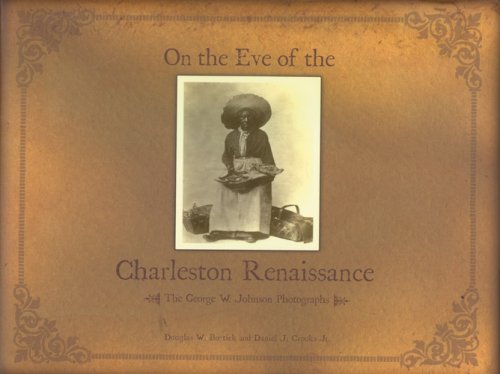
On the Eve of the Charleston Renaissance: The George W. Johnson Photographs reveals an incredible collection of black-and-white images taken by an unheralded turn-of-the-20th-century photographer, images that capture Charleston when she is coming into her own a half-century after the Civil War.
Charleston, S.C., was considered Queen of the South, until bloody conflict, famine, fire and infestation ravaged the city during the Civil War and reconstruction. When George W. Johnson came on the scene in the early 1900s, Charleston was catching her breath, on the verge of an era of great inspiration.
Photography was a relatively new art. Johnson, an inveterate tinkerer, built his own photographic equipment, then set about experimenting with light, composition and movement. Unlike his peers who mostly confined their work to the studio, Johnson took to the streets and byways of Charleston and the lowcountry. His black and white images freeze frame the city and her people during this time of great transition.
The collection of Johnson images compiled by authors Douglas Bostick and Daniel Crooks has never before been presented. These images and the thoughtful narrative accompanying them capture the spirit of a time rarely portrayed in Charleston histories. In addition, the authors portrayal goes a long way toward debunking some long-held myths about the history of Charleston during that time.
Johnson s photographs of black Americana are raw and real faces that show the wear of hard times and, sometimes, a moment s joy. Johnson captured Charlestonians at work and at play. He captured the architecture, churches, intricate ironwork and the wharf, as well as one of the most notable events of the time, the World s Fair held in Charleston in 1901-02.
Johnson was a harbinger of the great Charleston renaissance. His visual chronicle of the life of turn-of-the-century Charleston helped set the stage for the writers and artists who spirited the artistic renaissance, marking the restoration of Charleston as a cultural Mecca.
Doug Bostick is a sleuth of an historian who has spent more than two decades actively collecting and piecing together histories of the South. He is the author of three books and has written numerous articles that have appeared in historical journals, magazines and national newsletters.
Daniel J. Crooks Jr., a native Charlestonian, served as department head of criminal justice at Beaufort Technical College and Trident Technical College, and as an adjunct professor of sociology at the College of Charleston. A commissioned state constable, he has served the Town of James Island and the S.C. Police Corps. He is now engaged in a second career as a local historian and licensed tour guide.
Crooks is well versed on South Carolina criminal history, Charleston antiques, the Civil War and Charleston folk traditions. Over the years, he has researched and amassed a notable collection of S.C. dispensary bottles.