About this Item
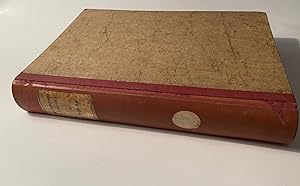
Merrill M. Flood. "Some Experimental Games" in "Management Science", Institute of Management Science, vol 5, 1958-1959, in the full volume of 497pp, with the Merrill on pp 5-26. Cloth-backed and cloth-tipped paper covered boards. Old paper label on the spine (bottom). VG copy. (Cited by 656) [++] This is the first publication of the classic paper written by Flood based on his work with Melvin Dresher (statistician and mathematician and author of "The Mathematics of Games of Strategy: Theory and Applications" in 1961) for the RAND Corp of the game theoretical Prisoner's dilemma model of cooperation and conflict. It was printed and circulated within the company for proprietary use in 1952 ("On Game-Learning Theory and Some Decision-Making Experiments") following experiments beginning in 1950. It was a major paper in the history of the new-ish branch of mathematics called "game theory" which was given life in John von Neumann's foundational paper of 1928. Like many works undertaken by RAND it took several years for the 1952 paper to be released to the general public this following the 1954 publication of the classic John Williams work, "The Complete Strategyst", which seemed to take the mysterious edge off of game theory and make it somewhat more accessible for wider circulation.[++] "Puzzles with the structure of the prisoner's dilemma were devised and discussed by Merrill Flood and Melvin Dresher in 1950, as part of the Rand Corporation's investigations into game theory (which Randpursued because of possible applications to global nuclear strategy). The title prisoner's dilemma and the version with prison sentences as payoffs are due to Albert Tucker, who wanted to make Flood and Dresher's ideas more accessible to an audience of Stanford psychologists. Although Flood and Dresher didn't themselves rush to publicize their ideas in external journal articles, the puzzle has since attracted widespread and increasing attention in a variety of disciplines . 'More than a thousand articles' about it were published in the sixties and seventies"--Stanford Encyclopedia of Philosophy (online) [++] ".I will start with the experiment performed by Dresher and Flood in 1950, which formulated the now famous Prisoner's Dilemma game (Flood, 1952, 1958), and continue with the work of Kalisch, Milnor, Nash, and Nering (1954), and Schelling (1957). -- Alvin Roth, "On the Early History of Experimental Economics" [++] "In January 1950, Merrill M. Flood and Melvin Dresher put game theory to the test under highly controlled laboratory conditions probably for the first time in history.--"Another frame, another game? Explaining framing effects in economic games" by Philipp Gerlach & Bastian Jaeger, Max Planck Institute for Human Development,Tilburg University. [++] "This paper reports the results of six experiments and analyses performed to explore the applicability of the non-constant-sum case of the theories of von Neumann-Morgenstern, and others, to the actual behavior of people playing games or involved in bargaining situations. The paper suggests directions in which the theory of games might be modified and extended to improve its applicability and usefulness. A split-the-difference principle is suggested to augment the usual theory, so as to specify the exact amount of payments to be made in an ordinary two-person bargaining situation such as the sale of a used car. The application of this principle seems satisfactory in the experiments. One experiment suggests that, in a sequence of trials in the same game situation, people tend to start near an equilibrium point and then try to find a better equilibrium, if there is one. The experiments show examples of non-optimal behavior of the bargainers when the judgment necessary to estimate the relevant payoff is obscure."--Abstract from paper. {WRITE for more details.].
Seller Inventory # ABE-1636988109735
Contact seller
Report this item