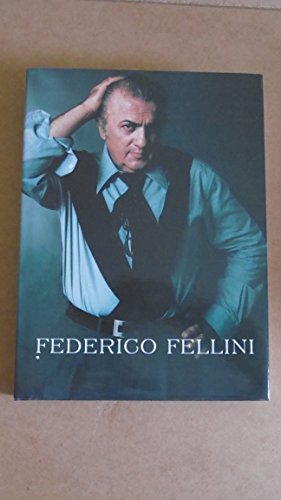
This is the first detailed appraisal of Federico Fellini's universe. Collected here, in addition to a biography and filmography, is a wealth of previously unpublished material allowing a detailed and often personal view of the master of cinema.
Published for the first time in these pages are the texts for four films Fellini never made, complete with sketches and notes; and the director's correspondence with other filmmakers, artists, and famous writers. Fellini's descriptions of his dreams, accompanied by splendid drawings, allow a glimpse of the subconscious world that contributed so much to the creation of his films. His comic strips of unmade films provide an intriguing account of his activity in the last years of his life. The filmography is illustrated with posters, sketches, and stills from all of Fellini's masterpieces - including his best-loved La Strada, 8 1/2, The Clowns, La Dolce Vita, Roma, Amarcord, and La Voce Della Luna.
The most revealing section of this lavishly illustrated but slight scrapbook consists of Italian film director Fellini's notes on or treatments of movies he was unable to make. These include a portrait of Venice, an autobiographically tinged version of Dante's Inferno, a study of the psychology of the actor and the adventures of the 1940s American comic-strip hero Mandrake. Fellini's colored drawings illustrating his dreams, accompanied by his analytical commentaries, provide a window onto the subconscious world that molded his films. Also included are lighthearted letters to and from filmmakers and writers; a biographical chronology and a filmography decked out with photographs and memorabilia; and Fellini's drawings, caricatures, comic strips and storyboards. Hard-core fans will want to own this miscellany.
Copyright 1995 Cahners Business Information, Inc.
The original Italian-language edition of the volume was published to coincide with a Fellini exhibition in Rome earlier this year. As such, the pictorial-including many reproductions (mostly in color) of Fellini's drawings and even more photographs from his films-takes precedence. What text there is (comprising 25 percent of the book) consists primarily of Fellini's notes for four films he never made, as well as another section that reprints parts of Fellini's dream journal. The book is lavishly produced, but unfortunately little of the illustrative material is captioned. Most importantly, what's missing is an overview of Fellini's significance in the history of film. Federico Fellini is fine for special collections, but others should look first to John Baxter's Fellini (LJ 11/1/94).
John Smothers, Monmouth Cty. Lib., Manalapan, N.J.Copyright 1995 Reed Business Information, Inc.