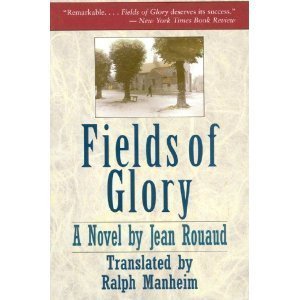
Synopsis
As their grandchildren kiddingly point out the crotchety foibles of their elders, three senior citizens explain where the habits came from, in a poignant story of survival and the desire to be loved.
Reviews
The "Fields of Glory," reads a five-centime patriotic souvenir, "Where the blood of France flowed in rivers from 1914 to 1916." The setting may be the rainy lower Loire Valley of the 1950s, but it is the WW I battlefields of Artois, Meuse, Lorraine and Yser that form the emotional backdrop to this poignant testament to the vitality of life that death cannot dim. A first effort by a then unknown newspaper vendor that went on to win the 1990 Prix Goncourt, Fields of Glory begins as a collection of utterly charming reminiscences of the eccentricities of family elders told by an unnamed and indeterminately aged narrator. In pure and graceful prose, beautifully translated by Manheim, Rouaud describes crotchety grandfather Burgaud with his equally difficult car, a cramped and leaky CV2, and maiden great-aunt Marie with her card file of saints--"A prefatory catalogue of terrifying symptoms refers the reader to the saint specializing in the corresponding disorder. The work of a lifetime." It is in the midst of this comedy of daily life that the melancholy subtext of three generations slowly emerges: the stories of the two young men who were casualties of the Fields of Glory and the family that remains to remember them.
Copyright 1992 Reed Business Information, Inc.
Rouaud's novel won the Prix Goncourt in 1990, a prize remarkable for the fact that Rouaud was no career writer but a very humble newsstand vendor who'd never before published a word. The book is not quite a novel, more a rich memoir, but on the grounds of prose style alone (which comes over quite convincingly in Ralph Manheim's fine English version), its prize-worthiness is clear. One of the children of a modest family living in the rainy Loire valley narrates, drawn back to the family's aged, especially a grandfather and spinster aunt--who throw off eccentricity and force of character like catherine-wheels: the grandfather's driving habits in his hilariously inadequate 2CV; the aunt's pious familiarity with every conceivable saint; the horror of WW I's carnage that lives undiminishable in the hearts of the elders. Here, Rouaud's great gift, not unlike the film master Jean Renoir's, is for specificity and high relief: there are emotional lineages and comic dimensions to things as well as people: ``If we needed a screw, a nut, a tube of paste, a razor blade, a watch spring, a marble, a pin, a pencil, a paper clip, a coin with a hole in it (for use as a washer), or the tiny watchmaker's screwdriver that we used to tighten the hinges of our glasses, we had only to plunge into the biotrope between the china cupboard and the top of the sideboard and locate the glass hors d'oeuvres dish that has served as a bath for the little white garnet-billed mandarin birds which, we never found out why, had one after another been found dead in their cage.'' A lovely, savory book. -- Copyright ©1992, Kirkus Associates, LP. All rights reserved.
This book represents a dialog between two generations seemingly far apart: three elderly veterans of the post-World War I era from the French lower Loire Valley and their grandchildren. Set in the 1950s, the novel is mainly a journey through the memories of grandfather, grandmother, and Aunt Marie, which reach as far back as battlefields near Ypres and Verdun--the "fields of glory." The memories are narrated from the perspectives of the grandchildren, whose initial boredom and impatience with the nostalgic stories from another era progressively become affection and understanding for the psychological urge to remember and be remembered. Rouaud was unknown even in France until he won the Prix Goncourt 1990, France's highest fiction honor, for this novel. Recommended for all libraries.
- Ali Houissa, Cornell Univ., Ithaca, N.Y.
Copyright 1992 Reed Business Information, Inc.
"About this title" may belong to another edition of this title.