Synopsis
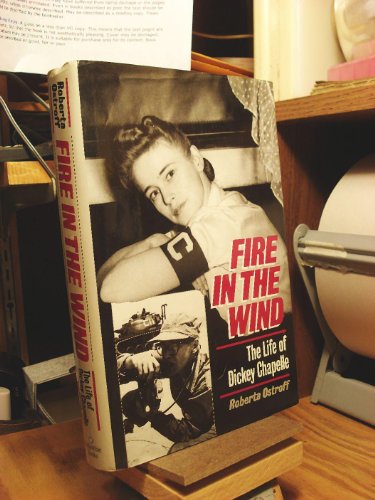
The biography of the first female combat photographer discusses her years at MIT, her marriage, her introduction to photography, and her work photographing the battle of Iwo Jima, the 1956 Hungarian uprising, the rise of Castro, and more.
Reviews
Free-lance journalist Ostroff (Rolling Stone, Reader's Digest, etc.) offers an engaging biography of feisty combat reporter/photographer Dickey Chapelle--the first American woman journalist killed in action. Born Georgette Louise Meyer in 1920, Chapelle grew up in a staid midwestern suburb where she spent her youth dreaming of flying airplanes and emulating her hero, Admiral Richard Byrd (she changed her first name to match his). After unceremoniously flunking out of M.I.T. and failing a course in flight instruction, she turned her energies to journalism and soon met her future husband, photographer Tony Chapelle, who taught her much about photography and wartime reportage. From then on, Chapelle was on her way, determined to be where the action was (``eyeballing history,'' she called it). Despite many rejections from the military (unused to having a woman at the front) and from the New York publishing establishment, Chapelle managed to cover most of the major wars and battles of the 20th century: Iwo Jima, the 1956 Hungarian uprising (when she spent five weeks in a Budapest prison), Cuba, Korea, Lebanon, Laos, and Vietnam, where she was killed while covering a platoon on patrol. Always an outspoken eccentric, with a voice like a ``marine drill sergeant,'' Chapelle was a tiny woman known for her signature uniform--fatigues, an Australian bush hat, dramatic Harlequin glasses, and pearl earrings--and her refusal to kowtow to authority. Ostroff chronicles her life with easy, workmanlike skill, drawing on interviews with those who knew her and on her extensive correspondence, articles, and reporter's notes. And while the author does not attempt to examine Chapelle's life so much as straightforwardly report it, she does provide moments of analysis and insight. A solid if not profound biography of a remarkable woman whose life story has been sorely neglected. (Two eight-page photo inserts--not seen.) -- Copyright ©1992, Kirkus Associates, LP. All rights reserved.
Dickey Chapelle, female correspondent and combat photographer, forced herself into the frontlines of democracy for 20 years from Iwo Jima to Vietnam. Going places no other woman had, where women weren't wanted, she covered post-World War II Europe, the 1956 Hungarian uprising, the rise of Castro in Cuba, and fighting in Korea, Lebanon, and Laos. Taken from previously unused Chapelle papers, this book presents a unique view of early Cold War confrontations from a woman's perspective. She spent time in a Budapest prison, months in the jungles of Cuba, and a year with Special Forces in Laos in 1961. Chapelle's greatest contribution came in Vietnam; during several tours of duty she spent months in the jungles on patrol with the Green Berets and U.S. Marines. Recommended.
- David Lee Poremba, Detroit P.L.
Copyright 1992 Reed Business Information, Inc.
"About this title" may belong to another edition of this title.