Synopsis
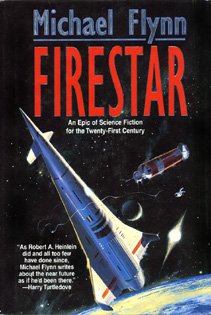
It is the dawn of the twenty-first century, and America is in trouble. Our public schools breed apathy and ignorance. Politics has become the art of the quick fix. But one woman has the vision and money to leverage change. Mariesa Gorley van Huyten, heiress to one of the great American fortunes, founds an educational subsidiary - Mentor Academies - and begins to subcontract public school systems in order to raise a new, less cynical generation. But her clandestine program is much larger, including the founding of a private space program, the eventual construction of an orbital power station, and supporting technological innovation on Earth.
Firestar is a chronicle of private enterprise and individual initiative - the story of one woman's quest that becomes the focus for a whole new world of the future. Her program lets teachers strive to teach, hires astronauts who have no government space program to fly for, and provides productive outlets for the idealistic desires of the rich and powerful - at least those who remain sane enough to have such desires in the face of a crumbling America. And it just might work.
Reviews
By 1999, well-meaning but misguided liberals, environmentalists and feminists have brought the U.S. economy to a near standstill. The space program is suffocating in red tape. The schools are collapsing. Technological innovation is virtually dead. All of this will change, however, because of one woman with vision, a capitalist with a heart of gold who has dedicated her life to reforming America's schools and to returning humanity to outer space. Over the past three years, a number of talented, politically conservative SF writers have turned their hands to scenarios much like this, among them Poul Anderson, Charles Sheffield and Larry Niven. Now Flynn (In the Country of the Blind, 1990) has produced one of the better books in this budding subgenre. His plot is complex, but it stays on track. His large cast of characters, particularly industrialist Mariesa van Huyten, are generally well drawn; even the villains have depth. Flynn's detailed description of new space technologies is entirely believable, too, though his solutions to current educational problems seem naive. This amalgam of ambitious SF and political agenda, the first in a projected series, may annoy some left-leaning readers, but it's likely to please most fans of thoughtful hard SF.
Copyright 1996 Reed Business Information, Inc.
Part one of an ambitious near-future multivolume saga from the author of Country of the Blind (not reviewed). Rich heiress Mariesa van Huyten has developed plans to save the human race. She sets up Mentor Academies, an educational foundation, and contracts to take over part of the crumbling New Jersey public school system, hoping to find among its hopelessly drug-ridden or sociopathic or cynical populations some sparks of creativity--talents that will be vital in the near future if humanity is to transcend its self-imposed limits. She also prepares the Prometheus project, using political, industrial, and economic pressure to develop a sustainable space program. Once established in space--where raw materials need only be gathered and processed; where there's nothing to pollute; where power from the sun is free and inexhaustible--humanity can expand and prosper without constraint. There is, however, a cloud on the horizon: one Cyrus Attwood, a reactionary who will use religion and violence to stop Mariesa and her progressive notions. Not quite a Libertarian party tract, but call this a textbook, retitle it How to Save the World, in Umpteen Very Large Installments, and you'd be close. A dense, vastly overstated yawner. -- Copyright ©1996, Kirkus Associates, LP. All rights reserved.
In this first novel by a Hugo Award nominee, an idealistic heiress tries to reverse the decline of 21st-century American society.
Copyright 1996 Reed Business Information, Inc.
"About this title" may belong to another edition of this title.