Synopsis
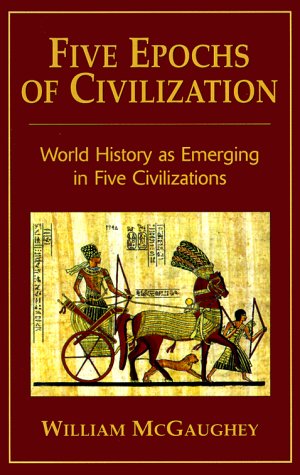
This book tells the story of civilized societies (c. 3000 B.C. to present) in terms of five civilizations that arose in successive periods of time. By and large, the period before Christ is characterized by wars and the formation of large political empires. Then, for the next millennium and a half, world religions dominated human culture. Next, the Renaissance launched a period of European political and cultural expansion in which commerce and secular education were primary foundations of civilized societies. We are now living in an age of news and entertainment disseminated through electronic media. Computer technology, with its capacity for two-way communication, threatens to replace this culture. (The last chapter predicts its future forms.) Five Epochs of Civilization helps readers to understand world history by splitting this into its component parts, by stressing the role of communications technology in changing cultures, and by showing how the structure of society has developed under such influences. This is a book relatively free of ethnocentric and regional bias. Its approach may well become the norm for world history in a global age.
About the Author
The author, now 59 years of age, studied history, philosophy, English literature, and other subjects at Yale University. His career, however, took him into non-academic fields as an accountant for several types of organizations and as owner/manager of rental properties in Minneapolis. The author has traveled in Europe and the Far East, including a years residence in Germany. He is now learning Chinese. His writing is known for wide-ranging research and clarity of expression. This is his fourth publication.
"About this title" may belong to another edition of this title.