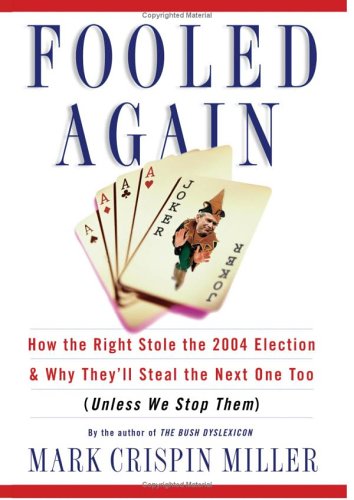
For Republicans, the 2004 presidential election was little short of miraculous: Behind in the Electoral College tally in the days leading up to the election, behind even on the very afternoon of the vote, the Bush ticket staged a stunning comeback. The exit polls, usually so reliable, turned out to be wrong by an unprecedented 5 percent in the swing states. Conservatives argued-and the media agreed-that "moral values" had made the difference. In his new book renowned critic and political commentator Mark Crispin Miller argues that it wasn't moral values that swung the election-it was theft. While the greatest body of evidence comes from the key state of Ohio-where the Democratic staff of the House Judiciary Committee found an extraordinary onslaught of Republican-engineered vote suppression, election-day irregularities, old-fashioned intimidation tactics, and illegal counting procedures-similar practices (and occasionally worse ones) were applied in Florida, Oregon, Pennsylvania, New Mexico, Nevada, Arizona, and even New York. A huge array of anomalies, improper practices, and blatant violations of the law all, by a truly remarkable coincidence, happened to swing in the Bush ticket's favor.This pattern-not one overwhelming fraud but thousands of little ones-is, in Miller's view, the new Republican electoral strategy. This incendiary new book presents massive documentation that the election was stolen and describes the mind-set, among both the major parties and the media, that could permit it to happen again.
Mark Crispin Miller is a professor of media studies at New York University and a well-known public intellectual. His writings on film, television, propaganda, advertising, and the culture industries have appeared in numerous journals and newspapers, including The Nation and the New York Times . He is the author of The Bush Dyslexicon: Observations on a National Disorder (2001) and Cruel and Unusual: Bush/Cheney's New World Order (2004). Miller has appeared on “Frontline,” “The PBS Newshour,” “The O'Reilly Factor,” “Washington Journal,” and Bill Moyers's “The Public Mind,” and has been a guest on countless radio programs. He is a regular commentator on Air America. He lives in New York.