Synopsis
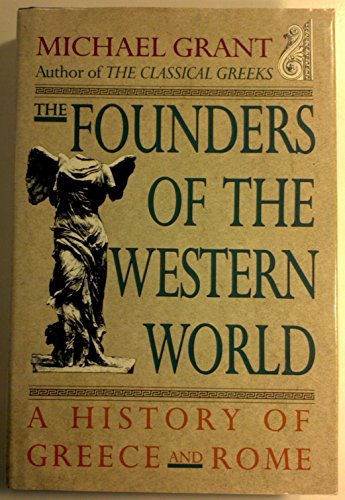
The renowned historian illuminates the world of ancient Greece and Rome, expounding on the influence of the classical states on the Western world today
Reviews
Grant, author of two dozen books on Greece and Rome, attempts to show how the two cultures were "inextricably intermingled." Instead of documenting this in systematic fashion, he presents a synthesis and update of his previous writings, recast on the basis of current research. This lively, terse, engaging history is a magnificent feast, marked by Grant's flair for the revealing detail and spiked with relevance for the present. Stressed is the enormous legacy that the Greeks adapted from Near Eastern art, literature, philosophy, religion and even city-state structure. We glimpse the Roman empire as a vast multiracial society that allowed an unprecedented measure of self-realization. If history for Grant is something made by great men, he also incorporates broad influences. For example, he points out key factors that made the Greek miracle possible--a favorable climate and ample leisure for the few. BOMC, QPB and History Book Club alternates.
Copyright 1991 Reed Business Information, Inc.
Here, Grant (The Visible Past, 1990; The Classical Greeks, 1989, etc.) offers a survey of the military, political, and cultural achievements of ancient Greece and Rome. While Grant has written separately about each of these empires, this is his first attempt to assess and compare the accomplishments of both in a single volume. He recapitulates the basic facts concisely and accurately, and provides an excellent introduction to the classical achievement, demonstrating that the civilizations of classical antiquity have had a pervasive effect on the development of the modern world. Both Greek and Roman civilizations left a substantial linguistic legacy to modern languages, and the art, philosophy, natural science, and literature of the Greeks, and the laws and political institutions of the Romans, have left an indelible imprint on contemporary civilization. Disappointingly, however, Grant provides less a fresh interpretation of the classical achievement and its impact on the modern world than a catalogue of facts that might have been derived from other sources (including Grant's many other books). Nonetheless, his succinct sketch of the continuities of classical history (for instance, the manner in which the Romans, having conquered first the Greek colonies in southern Italy and later Greece itself, were culturally transformed by the superior Greek culture) provides a more organic view of classical antiquity than that afforded by more detailed accounts. Without novel insights, but still a fine outline of the history and achievements of these ancient civilizations. -- Copyright ©1991, Kirkus Associates, LP. All rights reserved.
The author's prolific output (the Notes refer to 22 works) makes him well qualified to prepare a comprehensive summary of ancient history. Grant devotes some 116 pages of text to the Greeks and 81 to the Romans; the remaining pages include seven appendixes on specialized topics, and a lengthy comparative table of dates. Because of compression, omission, and style, this is not the most readable or entertaining of surveys and there are no illustrations; yet Grant manages to condense the essentials into one short volume, and for those libraries needing such a condensation, this work is recommended.
- Robert J. Lenardon, Siena Coll., Loudonville, N.Y.
Copyright 1991 Reed Business Information, Inc.
"About this title" may belong to another edition of this title.