
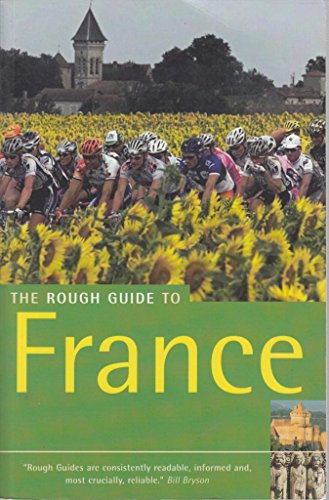
France (Rough Guide Travel Guides)
Baillie, Kate and Salmom, Tim and Catlos, B. Rian and Brown, Amy K. and Kaberry, Rachel and Ward, Greg and Dodd, Jan and Dubin, Marc and Blackmore, Ruth
ISBN 10: 1843530562 ISBN 13: 9781843530565
Published by Rough Guides, 2003
Used
Paperback
From
Reuseabook, Gloucester, GLOS, United Kingdom
Seller rating 5 out of 5 stars

AbeBooks Seller since June 24, 2014
This specific item is no longer available.
About this Item
Description:
Dispatched, from the UK, within 48 hours of ordering. This book is in good condition but will show signs of previous ownership. Please expect some creasing to the spine and/or minor damage to the cover. Seller Inventory # CHL1055280
Synopsis:
INTRODUCTION
The sheer physical diversity of France would be hard to exhaust in a lifetime of visits. The landscapes range from the fretted coasts of Brittany and the limestone hills of Provence to the canyons of the Pyrenees and the half-moon bays of Corsica, and from the lushly wooded valleys of the Dordogne and the gentle fields of the Loire Valley to the glaciated peaks of the Alps. Each region looks and feels different, has its own style of architecture, its own characteristic food and often its own dialect. Though the French word pays is the term for a whole country, many people frequently refer to their own region as mon pays – my country – and this strong sense of regional identity has persisted despite centuries of centralizing governments, from Louis XIV to de Gaulle.
Industrialization came relatively late to France, and for all the millions of French people that live in cities, the idea persists that theirs is a rural country. The importance of the land reverberates throughout French culture, manifesting itself in areas as diverse as regional pride in local cuisine and the state’s fierce defence of Europe’s agricultural subsidies. Perhaps the most striking feature of the French countryside is the sense of space. There are huge tracts of woodland and undeveloped land without a house in sight, and, away from the main urban centres, hundreds of towns and villages have changed only slowly and organically over the years, their old houses and streets intact, as much a part of the natural landscape as the rivers, hills and fields.
Despite this image of pastoral tranquillity, France’s history is notable for its extraordinary vigour. For more than a thousand years the country has been in the vanguard of European development, and the accumulation of wealth and experience is evident everywhere in the astonishing variety of things to see, from the Dordogne’s prehistoric cave-paintings and the Roman monuments of the south, to the Gothic cathedrals of the north, the châteaux of the Loire, and the cutting-edge architecture of the grands projets in Paris. This legacy of history and culture – la patrimoine – is so widely dispersed across the land that even the briefest of stays will leave the visitor with a powerful sense of France’s past.
The importance of these traditions is felt deeply by the French state, which fights to preserve and develop its national culture perhaps harder than any other country in the world, and private companies, who also strive to maintain French traditions in arenas as diverse as haute couture, pottery and, of course, food. The fruits of these efforts are evident in the subsidized arts, notably the film industry, and in the lavishly endowed and innovative museums and galleries. From colonial history to fishing techniques, aeroplane design to textiles, and migrant shepherds to manicure, these collections can be found across the nation, but, inevitably, first place must go to the fabulous displays of fine art in Paris, a city which has nurtured more than its share of the finest creative artists of the last century and a half, both French – Monet and Matisse for example – and foreign, such as Picasso and Van Gogh.
There are all kinds of pegs on which to hang a holiday in France: a city, a region, a river, a mountain range, gastronomy, cathedrals, châteaux. All that open space means there’s endless scope for outdoor activities – from walking, canoeing and cycling to skiing and sailing – but if you need more urban stimuli – clubs, shops, fashion, movies, music – then the great cities provide them in abundance.
About the Author: Rough Guides are written by expert authors who are passionate about both writing and travel. They have detailed knowledge of the areas they write about—having either traveled extensively or lived there—and their expertise shines through on every page. It's priceless information, delivered with wit and insight, providing the down-to-earth, honest read that is the hallmark of Rough Guides.
"About this title" may belong to another edition of this title.
Bibliographic Details
Title: France (Rough Guide Travel Guides)
Publisher: Rough Guides
Publication Date: 2003
Binding: Paperback
Condition: Used; Good