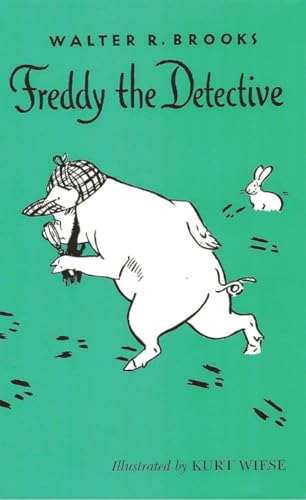
Often compared to Winnie‑the‑Pooh and The Wind in the Willows, this beloved classic offers timeless appeal, gentle satire, and language that rewards both young readers and adults alike.
Perfect for independent reading or family read‑alouds, this charming story proves that great detectives can come in the most unexpected forms.
Inspired by his latest reading of Sherlock Holmes, Freddy the Pig decides it’s time to put his keen mind to work. Setting up shop as a private detective on the Bean farm, Freddy quickly finds that mystery has a way of finding him. What begins with puzzling disappearances among the farm animals soon grows into a much larger case―one involving clever criminals, elaborate schemes, and a showdown that tests Freddy’s wits, courage, and sense of justice.
With the help (and occasional hindrance) of the farm’s unforgettable animal cast, Freddy tackles each case with humor, confidence, and a flair for dramatic deduction. From clever clues to a memorable trial scene in the barn, the story blends classic detective tropes with warm, laugh‑out‑loud storytelling.
First published in 1932 and illustrated by Kurt Wiese, Freddy the Detective remains one of the most beloved entries in Walter R. Brooks’s enduring Freddy the Pig series.
The Freddy the Pig series:
Freddy Goes to Florida
Freddy the Politician
Freddy the Detective
Freddy and the Flying Saucer Plans
The Collected Poems of Freddy the Pig
Walter R. Brooks was born in Rome, New York on January 9, 1886, and died in Roxbury, New York on August 17, 1958. Brooks attended the University of Rochester and, after graduation, worked for the American Red Cross and the Woodrow Wilson Foundation. He became associate editor of Outlook in 1928 and subsequently was a staff writer for several magazines, including The New Yorker. The short stories he began writing at this time were published in The Saturday Evening Post, Atlantic Monthly, and Esquire. Brooks's short story "Ed Takes the Pledge" was the basis for the 1950s television series Mr. Ed, but his most lasting achievement is the Freddy the Pig series, which began in 1928 with To and Again (Freddy Goes to Florida). He subsequently wrote twenty-five more delightful books starring "that charming ingenious pig" (The New York Times), all of which are now available from The Overlook Press.
Kurt Wiese (1887-1974) illustrated over 300 children’s book and wrote and illustrated another 20 books. He received two Newbery Awards and two Caldecott Honor Book Awards.