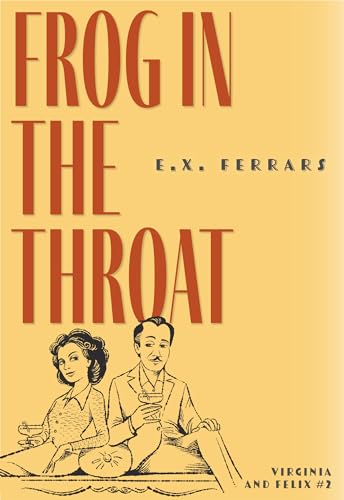
Virginia’s trouble is that whenever something awful happens, it is far too easy to imagine that her husband, Felix, is behind it somehow. She doesn’t
want to believe this; after all, even if they haven’t lived together for ages, at one time she was terribly fond of him. He’s quite charming, he dresses well, he knows wine...he would have been a perfectly satisfactory husband if he weren’t such an utter cad! He lies, you see. He lies the way other people brush hair off their foreheads, all the time and without even noticing they’re doing it.
Virginia has even managed to tell herself that this is a useful trait, that because Felix is such a scoundrel, he has a special genius for sniffing out other people’s lies, and this makes him a good detective. And perhaps he is, but there’s no denying that when awful things happen, Felix is often nearby. The latest awfulness is a local writer shot dead on the eve of her engagement—and right on time, Felix has turned up, like a charming, well-dressed, bad penny.
Morna Doris MacTaggart was born in Burma in 1907 and sent at the age of six to a prestigious boarding school in England. After an early marriage and the publication of two novels, in 1940 her life was turned upside-down when she both met Robert Brown and published Give a Corpse a Bad Name (as E.X. Ferrars), her first mystery and the first in what would become the five-book “Toby Dyke” series. She and Brown married in 1945 and in 1951 moved to the US, though they returned to the UK only a year later, sickened by America’s turn toward McCarthyism. In 1953 Ferrars helped found the Crime Writers’ Association. The couple lived in Edinburgh for 25 years, during which Ferrars wrote more than 35 crime novels, finally returning to series mystery―first with the “Virginia and Alex Freer” books and then with “Andrew Basnett”―in the late 1970s, after a move to Oxfordshire. She died in 1995, having published more than 75 novels and numerous short stories, nearly all of them involving dead bodies.