About this Item
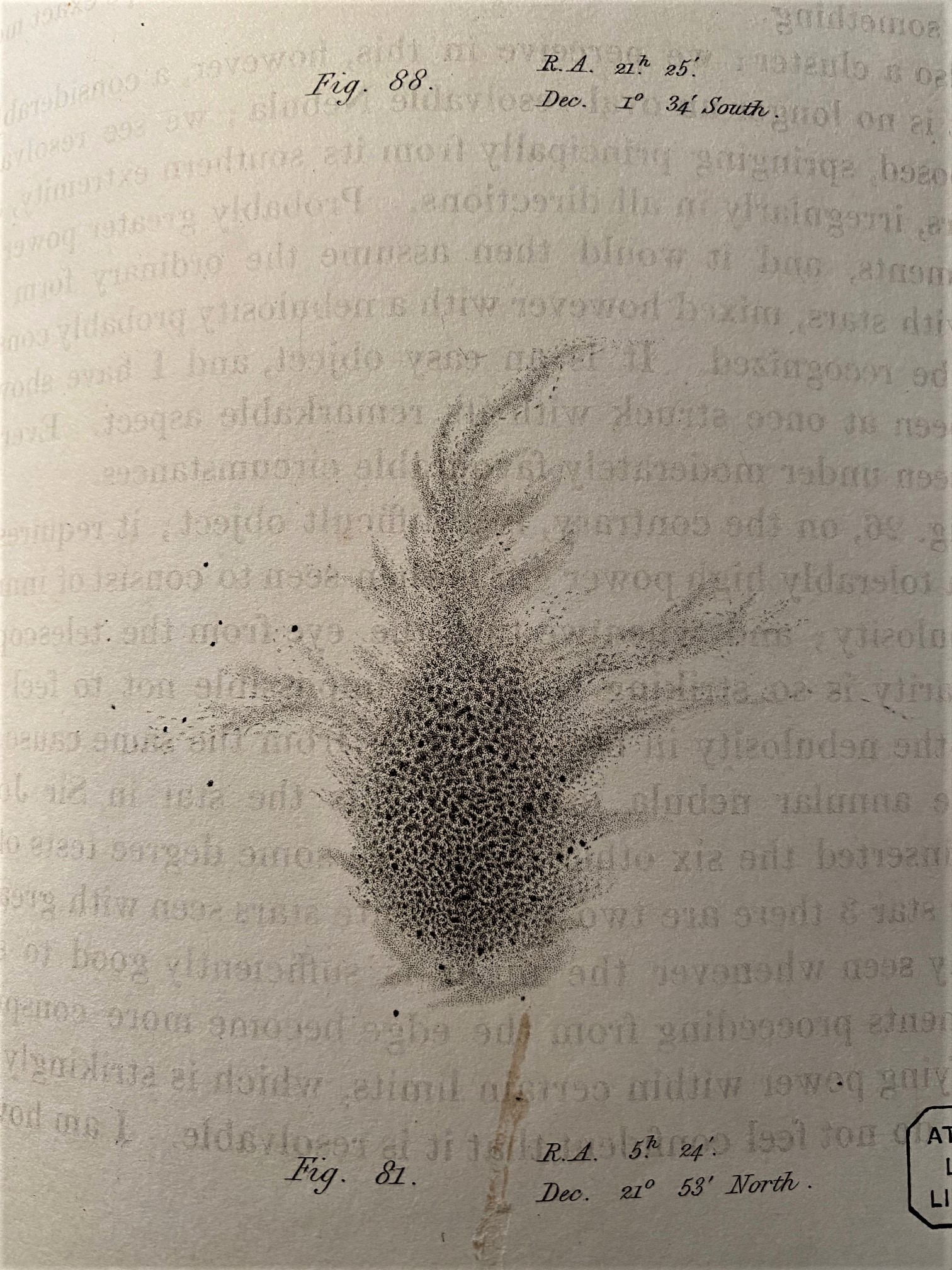
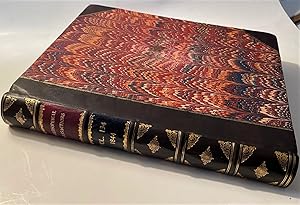
Boole, George. "On a General Method in Analysis", bound with: William Parsons [Earl of Rosse], C., "Observations on Some of the Nebula Both found in "Philosophical Transactions of the Royal Society of London", vol 134, printed by Richard and John Taylor, London, 1844. Ample margins. Very clean text. Rebound recently in half-calf and marbled boards, raised bands, and red and black leather spine labels. Lovely copy, fresh and crisp and bright. There are former unobtrusive and small (15mm) ownership stamps on the plates and on the title page. The Boole appears on pp 225-282 and the Earl Rosse on pp 321-4 (with two engraved plate illustrations) in the full volume of ix, 324, 28pp, with 19 plates. As I said, the binding is new, and the text Fine. [++] "George Boole, (born November 2, 1815, Lincoln, Lincolnshire, England died December 8, 1864, Ballintemple, County Cork, Ireland), English mathematician who helped establish modern symbolic logic and whose algebra of logic, now called Boolean algebra, is basic to the design of digital computer circuits."--Encyclopedia Britannica. [++] According to M. Panteki (in "The Mathematical Background of George Boole's Mathematical Analysis of Logic"(1847) found in Gasser J. (eds) "A Boole Anthology", Synthese Library) the paper offered here is "Boole's first mathematical masterpiece, a work grounded on the laws of combination of non-commutative symbols, which apparently convinced Boole of the immense power afforded by symbolical methods, a power largely due to their main property of not depending upon conditions of their interpretation." "In 1843, Boole began applying algebraic methods to the solution of differential equations. He wrote a lengthy paper [the one offered here] [that] investigates differentiation and differential equations from an operator point of view and introduces Boole's new algebra of classes . This boolean algebra contributed to freeing mathematics from number systems, and pushed mathematics a step further towards abstraction. For this paper, Boole received the Royal Society's Gold Medal, the first ever awarded for mathematics. It was a turning point in Boole s career and brought his name to the attention of leading mathematicians and scientists."--Boole website, University College Cork.[++] Now to the Earl Rosse paper on the so-called (but not by him) "Crab Nebula" (M1)." The drawing is reproduced here and described as follows: "Drawing of the Crab Nebula by William Parsons, the Third Earl of Rosse. This drawing gave rise to the name "Crab Nebula". It was created using the 36-inch reflector at Birr Castle about 1844. On the basis of this observation, Lord Rosse gave the following description:". a cluster; we perceive in this [36-inch telescope], however, a considerable change of appearance; it is no longer an oval resolvable [mottled] Nebula; we see resolvable filaments singularly disposed, springing principally from its southern extremity, and not, as is usual in clusters, irregularly in all directions. Probably greater power would bring out other filaments, and it would then assume the ordinary form of a cluster. It is stubbed with stars, mixed however with a nebulosity probably consisting of stars too minute to be recognized. It is an easy object, and I have shown it to many, and all have been at once struck with its remarkable aspect. Everything in the sketch can be seen under moderately favourable circumstances." Obviously, the Earl had mistaken the filaments he saw as indications for resovability! In 1848, Lord Rosse re-observed this object with the 72-inch reflector, and saw a remarkably different picture, which was represented in a new drawing in 1855 by R.J. Mitchell - this second picture was approved as "the best representation" of this object by his son, Laurence Parsons, the Fourth Earl of Rosse.:--Messier website.
Seller Inventory # ABE-1640030239670
Contact seller
Report this item