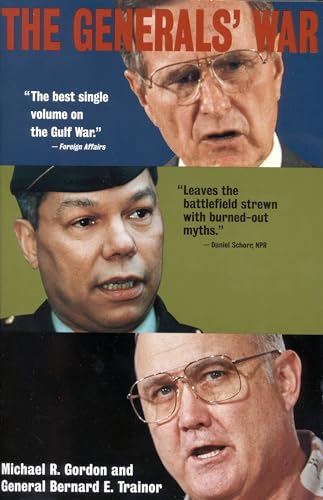
An account of the war in the Persian Gulf takes readers behind the scenes at the Pentagon and the White House to provide portraits of the top military commanders and to discuss what worked and what did not.
This inside view of the battle between high U.S. command officers in the conflict with Iraq is a fascinating and sustained analysis of the friction that takes place in real warfare. Writer Gordon teams with retired Marine general Bernard Trainor to record the struggles of the generals of the combined services in their endeavor to plan and execute the massive 500,000-troop movement that achieved the short and stunning victory over Iraqi forces. An important question is posed: Why didn't the generals press on to dismantle the Republican Guard of Saddam Hussein, and what were the consequences of their decision against such an act? The Air Force strategy called for constant precision bombing in the heart of Baghdad. Over 30 days of bombing weakened but did not finish off the enemy. The land attack, whose success was clearly foreshadowed, was concluded too soon and allowed Hussein to keep the Republican Guard intact. The authors believe that the cautious philosophy of General Colin Powell and the eagerness of General Norman Schwarzkopf to get out with an Army victory, combined with the decision of President Bush and his advisers, led to the unfortunate staying power of Saddam Hussein. The final conclusion is undeniable--the gate had not been closed in Iraq, and this book explains why. Eugene Sullivan