About this Item
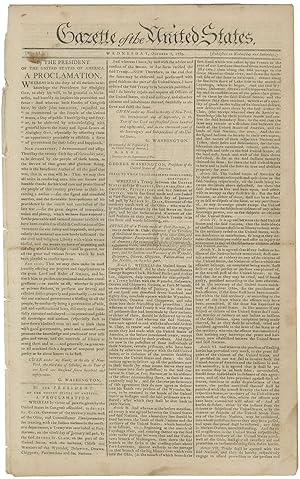
Gazette of the United States. New York, N.Y., October 7, 1789. 4 pp., In addition to the Thanksgiving Proclamation on page one, this issue also includes: a printing of the Treaty of Fort Harmar between the United States and the Wyandot, Delaware, Ottawa, Chippewa, Pattawatima, and Sac Indian nations (p. 1, col. 2 to p. 2, col. 2). A report from London about an African Genius (p. 2, col. 2). And a report on the proceedings of Congress, including an act to suspend part of the Tonnage Duties Act (p. 4 col. 3). 9 1/2 x 14 3/4 in. Overall fine. Archivally framed. "to recommend to the People of the United States a day of public thanksgiving and prayer to be observed by acknowledging with grateful hearts the many signal favors of Almighty God especially by affording them an opportunity peaceably to establish a form of government for their safety and happiness. for the peaceable and rational manner in which we have been enabled to establish constitutions of government for our safety and happiness. for the civil and religious liberty with which we are blessed; and the means we have of acquiring and diffusing useful knowledge"On September 28, 1789, just before the closing of the First Federal Congress, the Senate added its assent to a House resolution requesting that George Washington be asked to call for a day of public thanksgiving and prayer. Later that day, Congress passed the Bill of Rights to be sent to the states for their ratification, and on the next day the first session of the first Federal Congress was adjourned. On Saturday, October 3, Washington issued America's first presidential Thanksgiving Proclamation. The Gazette printed it in full on the first page of this, their next edition, Wednesday October 7th. Historical BackgroundOn September 25, 1789, as the momentous first Federal Congress drew to its close in New York, the new national capital, Representative Elias Boudinot introduced a resolution calling on President Washington to "recommend to the people of the United States a day of public thanksgiving and prayer . . . acknowledging, with grateful hearts, the many signal favors of Almighty God, especially by affording them an opportunity peaceably to establish a form of government for their safety and happiness." A leading opponent of the resolution, Thomas Tudor Tucker, asked, "Why should the President direct the people to do what, perhaps, they have no mind to do?" The skeptical Congressman noted that the people "may not be inclined to return thanks for a Constitution until they have experienced that it promotes their safety and happiness." He also argued that it was a religious matter and thus proscribed to the new government. South Carolina Representative Aedanus Burke balked at the idea of a federally-imposed day of thanks, stating he "did not like this mimicking of European customs, where they made a mere mockery of thanksgivings." Regardless, Boudinot and his colleagues in the House passed the resolution?-?one of their last pieces of business before completing the proposed Bill of Rights. The Senate concurred three days later, and a delegation was sent to meet the President. George Washington, who had in fact anticipated the question in a letter to James Madison a month earlier, readily agreed. On October 3, George Washington signed the document offered here, America's first Presidential Thanksgiving Proclamation. Washington employed the exact language of the resolution to begin his proclamation, though he went further, giving thanks for "tranquility, union, and plenty" and asking the Almighty to guide the new nation's leaders and government. He used the same approach a year later when he wrote what is now one of his most celebrated letters: "For happily the Government of the United States gives to bigotry no sanction, to persecution no assistance, [and] requires only that they who live under its protection should demean themselves as good citizens, in giving it on all o. (See website for full description).
Seller Inventory # 23257.99
Contact seller
Report this item