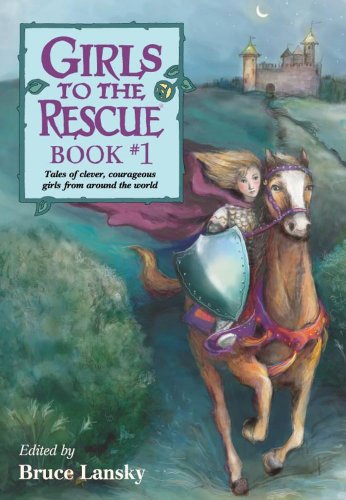
In most heroic tales, a helpless young lady waits around for a prince to rescue her. But the spunky girls in this entertaining series are much too busy saving the day to await Prince Charming. These adaptations and original stories from around the world inspire readers to become a new kind of heroine. If you enjoy the stories in this book, look for more fun adventures in the other books in the series.
In most heroic tales, a helpless young lady waits around for a prince to rescue her. But the spunky girls in this entertaining series are much too busy saving the day to await Prince Charming. These adaptations and original stories from around the world inspire readers to become a new kind of heroine. If you enjoy the stories in this book, look for more fun adventures in the other books in the series. This first book contains the following short stories: "The Fairy Godmother's Assitant" (an original story), "Grandma Rosa's Bowl" (adapted from a Grimm Brothers' Story), "For Love of Sunny" (an original story), "Carla and the Greedy Merchant" (adapted from a folktale), "Savannah's Piglets" (adapted from a folktale), "Kimi Meets the Ogre" (an original story), "The Innkeeper's Wise Daughter" (retold from a Russian folktale), "The Royal Joust" (an original story), "Chardae's Thousand and One Nights" (adapted from a story in The Arabian Nights) and "Lian and the Unicorn" (an original story).
Grade 3-6-A collection of stories about resourceful young women, written to offset the helplessness of traditional folktale heroines. Most are original tales that incorporate folkloric elements. In Lansky's own "The Fairy Godmother's Assistant," a young woman advises Cinder-Ella to sew her own ball gown. She goes on to council a king and arbitrate a royal dispute, relying on her own wits and common sense. "Grandma Rosa's Bowl," based on an old diary discovered in an antique store in Mexico, is about a girl whose wisdom and sensitivity help her settle a painful family feud. The stories are set in a variety of countries, but occasionally a sincere desire to represent many cultures seems lacking. For example, in Vivian Van de Velde's "Lian and the Unicorn," the unicorn seems to have been plunked down in China simply to fulfill some vague multicultural requirement. Nevertheless, most of these stories are fast paced and humorous. Readers who enjoyed Robert Munsch's The Paper Bag Princess (Firefly, 1980) but aren't yet ready for Jack Zipes's immortal Don't Bet on the Prince (Routledge, 1986) will enjoy them.
Rebecca O'Connell, Carnegie Library of Pittsburgh
Copyright 1995 Reed Business Information, Inc.