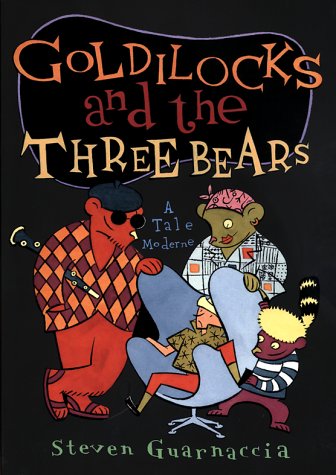
Something is different in this retelling of the classic story of the girl with the golden locks. Goldilocks, as usual, discovers the three bears' house in the woods. She ventures inside and makes herself at home, sitting in the chairs, samples the meal laid on the table, and taking a nap. But the bears-they're an entirely new breed! Steven Guarnaccia's comical, stylized artwork delivers bears who are hip; they have a sense of style and a love of design. Their 1950s split-level home is filled with cool furniture created by an international crowd of celebrated designers, from Alvar Aalto to Charles and Ray Eames to Isamu Noguchi!
Children and parents alike will delight in this new edition of the beloved story. And when they look at the endsheets, which provide the name of each decorative object and its creator, they may even pick up a design tip or two. STEVEN GUARNACCIA is an illustrator and designer whose comic and stylized illustrations have appeared in many national and international magazines and newspapers, including the New York Times, Abitare, and House and Garden. Guarnaccia has also designed greeting cards for the Museum of Modern Art, New York and watches for Swatch . He is the author of several books for children and adults. He lives and works in Montclair, New Jersey, with his wife and son. 32 pages of illustrations in full color, 9 x 13"
Grade 5 Up-The classic story of Goldilocks could be described as a chary tale, meaning cautionary, but in this version, it is truly a "chairy" tale. Guarnaccia's retelling features chair and furniture designs and fashionably hip bears. Papa Bear wears shades and a beret and plays clarinet; Mama Bear wears sandals and a bandanna and makes chili; Baby Bear sports a coonskin hat; and Goldilocks is done up with bangs and a ponytail. Their split-level house is filled with furnishings created by an international design crowd from Charles and Ray Eames to Isamu Noguchi to Terence Conran (the endpapers provide the legend). The large pages provide ample room for the stylized art, a mix of 1950s modernism and The Jetsons. Black India ink is used for some backdrops and for a strong line, which sets off the colorful patterns, shapes, and hand-lettered text. Diverting from the drama and playfulness of the story to focus on furniture design shifts the audience from children to adults. Be chary, the idea is clever but of limited interest and use for children's collections.
Julie Cummins, New York Public Library
Copyright 2000 Reed Business Information, Inc.
In Guarnaccia's visually appealing salute to modern design, that crazy chick Goldilocks crashes out in an ultra-stylish pad. When the Three Bears get home, they proceed to the kidney-shaped table and find their lunch (served in a vintage 1956 Swedish casserole) half eaten. "It's so unfair, someone's been eating my chili, and has eaten it all up," Baby Bear laments. Even worse, someone has broken his 1946 Eames chair and deflated Mama Bear's 1967 Italian inflatable bed. Luckily for Goldilocks, these Bears don't growl or file an insurance claim, they just watch her hasty retreat from a window of their retro-chic split-level home. The familiar story simply provides a context for the hip furnishings. Guarnaccia details his characters in India ink, watercolor and opaque marker; his generous, fluid line and 1930s cartoon aesthetic pump up the nostalgic feel. The endpapers include sketches of the furniture items, each labeled with a designer's name and date, found throughout the book. Those who yearn for Scandinavian furniture or George Nelson's 1950s-era clocks will covet the Three Bears' wares. Warning: this fetishistic fairy tale, which may do more for parents than for their progeny, could cultivate an eBay shopper. Ages 3-7. (Apr.)
Copyright 2000 Reed Business Information, Inc.