Synopsis
In The Good Citizen, some of the most eminent contemporary thinkers take up the question of the future of American democracy in an age of globalization, growing civic apathy, corporate unaccountability, and purported fragmentation of the American common identity by identity politics.
Reviews
This collection of essays, according to the editors (who teach social ethics and philosophy, respectively, at the University of San Francisco), concerns "citizenship, considered as an ideal and a practical identity, and embracing of both moral value and pragmatic institution." It's a very mixed bag, however, which includes some fairly clear arguments but also some others that devolve into heavy-handed leftism or academic inscrutability. Sociologist Robert Bellah (Habits of the Heart) offers some practical advice: fight to reform global economic agreements like NAFTA; "focus on the real problems of the underclass"; fuse the voluntary sector and the government. Undeterred by the widespread mockery of his concept of "the politics of meaning" (and his book of the same name), Tikkun founder Michael Lerner recognizes how liberals fixated on economics and rights issues ignore people's spiritual and psychological needs. But some essays contain overheated rhetoric: "financial status determines whether one is deemed a criminal," declares Barbara Christian. Mendieta dismisses critics of identity politics by declaring neoliberal politics and economic restructuring the real causes of civic decline. Berkeley professor of rhetoric Judith Butler closes the book with an analysis of homosexuality in the military that founders on sentences like this: "Only within that regulatory discourse is the performative power of homosexual self-ascription performatively produced." Citizenship, presumably, requires a common language. Not enough of the essays in this collection take that to heart.
Copyright 1999 Reed Business Information, Inc.
Essays exploring the meaning and nature of citizenship. In their introduction, Batstone and Mendieta (both of the University of San Francisco) challenge readers to truly consider what it means to be an American citizen. This challenge is well met and spurred on by this collection of essays written by some of America's most innovative social thinkers. The essayists agree that citizenship is a good thing, expressing the obligation each has to the community and the community in turn to individual autonomy. Two themes thus emerge. One is concerned with conditions that may be threatening this delicate balance between self and community. Cornel West worries that amid a culture of commodification and consumption, personal gratification will cause the American tradition of struggle for freedom and dignity to atrophy. Robert N. Bellah shows how the extreme polarization of wealth in America over the past two decadesamong a few ``haves,'' many more ``have nots,'' and a struggling, frightened middle stratummakes the notion of a common civic responsibility virtually impossible. The second theme is how citizenship is being, or ought to be, redefined. Batstone sees traditional communities being replaced by ``the [communication] network society,'' which transcends borders and can inform and empower citizens in new, exciting ways. Barbara Christian examines two views of America, one based on race (whiteness) the other on contract and consent. She and other contributors focus on how diverse ethnic and racial groups might share in American citizenship without forfeiting the right to group self-definition. Judith Butler engages in a similar exercise concerning gay men and lesbians. All contributors are vaguely ``on the left,'' though the ``left'' may have much to quibble with hereBellah's emphasis on spirituality, Batstone's rosy image of the network society. Also, not all the essays are of equal quality. West is, as usual, eloquent and impassioned; Butler is, as usual, erudite yet so opaque as to be unreadable. Thoughtful and thought-provoking essays on a topic of inestimable importance. -- Copyright ©1999, Kirkus Associates, LP. All rights reserved.
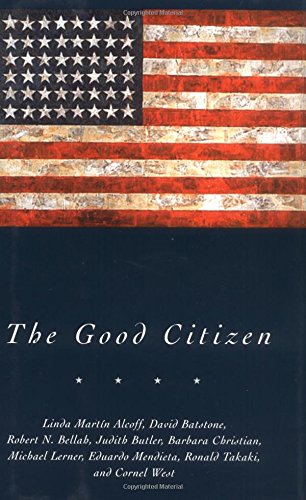
This collection of essays by nine intellectuals is thought-provoking, passionate, and stirring. The editors open the discourse by pointing out that the picture of an American flag on the cover is not a photograph of the flag but a painting used in advertising jeans and T-shirts. The flag, which isn't inherently significant, carries many messages as an icon. Who is a good citizen? The question is refracted through the topical issues of morality, the polarization of Left and Right, the ethics of technology, and the groups excluded by the white establishment. Cornel West examines democracy framed by class distinctions and racial exclusion. Batstone outlines 20 rules for net life that substitute for community in cyberspace. Mendieta and Linda Martin Alcoff explore the Latin American identity formed in opposition to the colonial and imperial policies of Spain and Portugal. Recommended for public and academic libraries, this is required reading for all citizens.?Kevin Whalen, Somerset Cty. Lib., NJ
Copyright 1999 Reed Business Information, Inc.
"About this title" may belong to another edition of this title.