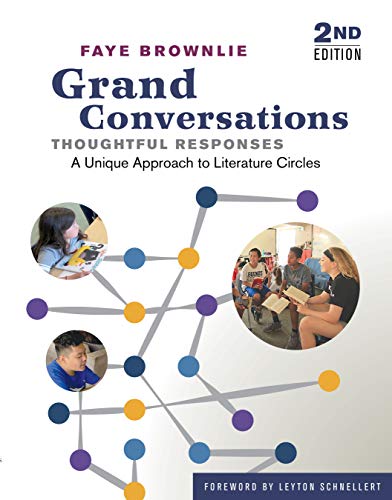
Grand Conversations, Thoughtful Responses is built upon the premise that all students can become active, independent, thoughtful readers. The structures and strategies in this book are proven to help students develop confidence and competence in their reading. Student engagement with text soars through participation in grand conversations with peers and reflecting on reading with thoughtful, written responses. This unique approach includes:
- student choice in books
- students reading at their own pace, thus creating flexible groups
- literature circles where students discuss the shared text they are reading
- strategies for teaching written response
- strategies for co-creating assessment criteria
- additional activities to develop and deepen comprehension
- book lists
This new edition has been expanded to include examples and book lists for grades K to 12.
Faye Brownlie’s (she/her/hers) goal is to build capacity with teachers, co-planning and co-teaching, providing seminars, workshops, and keynote presentations in Canada, the United States, Europe, and Asia. Passionate about including and supporting all learners, her work focuses on literacy, teaching for thinking, assessment, and inclusion. She has co-authored many books for teachers, including It’s All About Thinking series for Portage & Main Press and most recently, a 2nd edition of Grand Conversations Thoughtful Responses. Faye believes, ‘We know enough, collectively, to teach all our students to read, and more importantly, to create readers who not only can read but want to read."
Leyton Schnellert, PhD, (he/his/him) is an associate professor in UBC’s Department of Curriculum & Pedagogy and Eleanor Rix Professor in Rural Teacher Education. He focuses on how teachers and teaching and learners and learning can mindfully embrace student diversity and inclusive education. Dr. Schnellert is the Pedagogy and Participation research cluster lead in UBC’s Institute for Community Engaged Research, inclusive education research lead in the Canadian Institute for Inclusion and Citizenship, and co-chair of BC’s Rural Education Advisory. His community-based collaborative work contributes a counter argument to top-down approaches that operate from deficit models, instead drawing from communities’ funds of knowledge to build participatory, place-conscious, and culturally responsive practices. Leyton works and learns on the traditional, ancestral, and unceded territory of the Sinixt who were declared extinct by Canada’s government in 1956 and stands in solidarity with the Sinixt in their reclamation efforts.
Leyton has been a middle and secondary years classroom teacher and a learning resource teacher for grades K–12. His books, films, and research articles are widely referenced locally, nationally, and globally.