Synopsis
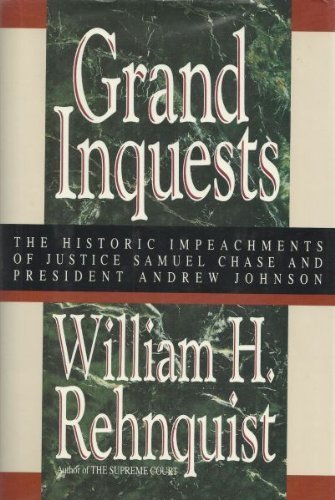
The Chief Justice presents a dramatic account of two precedent-setting impeachment cases that strengthened the concept of separation of powers and further defined the institutions of American government.
Reviews
The importance the framers of the Constitution attributed to the balance of powers among the three branches of our government is brilliantly illustrated here by Chief Justice Rehnquist ( The Supreme Court ). Clear expositions of historical and political premises, along with lively evocations of chief players and their milieus, animate the author's engrossing account of the Senate's 1805 impeachment trial and its acquittal of the choleric Supreme Court Justice Chase for his alleged attack on the Constitution during his concurrent term as a circuit court judge. The politically motivated impeachment trial of President Johnson in 1868--he was also acquitted--concerned his removal from office of Secretary of State Edwin Stanton without Senate approval, an alleged violation of the debatable Tenure of Office Act. While Chase's acquittal, writes Rehnquist, assured "the independence of federal judges from congressional oversight" of their judicial opinions, the repeal of the Tenure of Office Act by the Supreme Court in 1926 freed presidents to remove executive officers from their posts at will. Thus Rehnquist concludes from his present-day perspective that with the threat of congressional impeachment largely curtailed--except for criminal offenses--the chief executive is now directly answerable only to the electorate. Photos not seen by PW.
Copyright 1992 Reed Business Information, Inc.
In a pleasant if unremarkable history lesson, America's Chief Justice (The Supreme Court, 1987) recounts ``two episodes in American history'' that were ``of extraordinary importance to the American system of government''--the impeachment trials of, in 1805, US Supreme Court Justice Samuel Chase and, in 1868, President Andrew Johnson. Rehnquist straightforwardly narrates the case of Chase, an ornery Federalist justice who was impeached by Jeffersonian Republicans for bias, intemperate pronouncements from the bench, and erroneous rulings in his conduct of criminal trials under the controversial Sedition Act--as well as that of Johnson, whom Radical Republicans impeached for dismissing Secretary of War Stanton in violation of the Tenure in Office Act. The author points out that both men were acquitted only because a number of senators defected from their party, and argues that the acquittals in these cases strengthened the constitutionally mandated separation of powers. In the case of Chase, Rehnquist asserts that ``the history of removals of federal judges by impeachment and conviction after the Chase acquittal...is testimony to the complete independence of federal judges from removal because of their judicial decisions.'' This is largely true, although Rehnquist fails to note the politically motivated efforts of the Nixon Administration to force liberal justices William O. Douglas and Abe Fortas from the Supreme Court. In the case of Johnson, Rehnquist correctly observes that, as a result of Johnson's acquittal, there has been only one serious attempt to impeach a president (Nixon), and that was based on criminal activity rather than disagreements on policy. The Chief Justice relates a great deal of American history, much of which, while interesting (and familiar), is tangential to his basic story. Not a seminal work of history, but a well-told and worthwhile look at two important incidents in the history of American government. (Eight pages of b&w photos--not seen.) -- Copyright ©1992, Kirkus Associates, LP. All rights reserved.
Supreme Court Chief Justice Rehnquist has written a necessary and proper account of two of the most significant trials and "cases" in American legal and political history: the 1804 impeachment of Justice Samuel Chase of the U.S. Supreme Court and the 1868 impeachment of President Andrew Johnson. According to the author, U.S. legal and political history would have turned out differently and worse had either Chase or Johnson or both been convicted. With a lawyer's attention to detail, Rehnquist marshalls his facts to prove that impeachment, briefly adumbrated in the Constitution, was designed as a judicial type of inquiry into specific acts rather than a vote of confidence over policies. Impeachment is often confused with conviction; this good book clearly shows the important difference. Recommended for all libraries.
- Stephen K. Shaw, Northwest Nazarene Coll., Nampa, Id.
Copyright 1992 Reed Business Information, Inc.
"About this title" may belong to another edition of this title.