
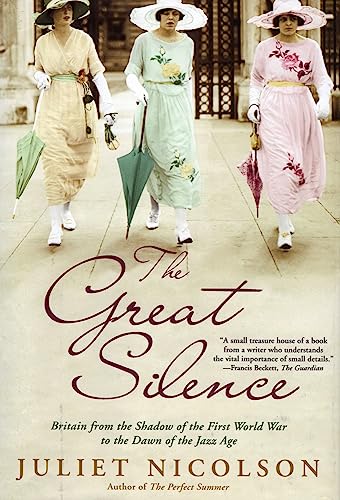
The Great Silence: Britain from the Shadow of the First World War to the Dawn of the Jazz Age
Juliet Nicolson
ISBN 10: 0802119441 ISBN 13: 9780802119445
Published by Grove Press, 2010
Used
Hardcover
From
ThriftBooks-Phoenix, Phoenix, AZ, U.S.A.
Seller rating 5 out of 5 stars

AbeBooks Seller since May 14, 2010
This specific item is no longer available.
About this Item
Description:
May have limited writing in cover pages. Pages are unmarked. ~ ThriftBooks: Read More, Spend Less. Seller Inventory # G0802119441I4N00
Synopsis:
Juliet Nicolson pieces together colorful personalities, historic moments, and intimate details to create a social history of the two years following the Great War in Britain. Not since Nicolson’s The Perfect Summer have we seen an account that so vividly captures a nation’s psyche at a particular moment in history.
The euphoria of Armistice Day 1918 vaporizes to reveal the carnage that war has left in its wake. But from Britain’s despair emerges new life. For veterans with faces demolished in the trenches, surgeon Harold Gillies brings hope with his miraculous skin-grafting procedure. Women win the vote, skirt hems leap, and Brits forget their troubles at packed dance halls. The remains of a nameless soldier are laid to rest in the Tomb of the Unknown Soldier at Westminster Abbey. “The Great Silence,” observed in memory of the countless dead, halts citizens in silent reverence.
Nicolson crafts her narrative using a lively cast of characters: from an aging butler to a pair of newlyweds, from the Prince of Wales to T.E. Lawrence, the real-life Lawrence of Arabia. The Great Silence depicts a nation fighting the forces that threaten to tear it apart and discovering the common bonds that hold it together.
The euphoria of Armistice Day 1918 vaporizes to reveal the carnage that war has left in its wake. But from Britain’s despair emerges new life. For veterans with faces demolished in the trenches, surgeon Harold Gillies brings hope with his miraculous skin-grafting procedure. Women win the vote, skirt hems leap, and Brits forget their troubles at packed dance halls. The remains of a nameless soldier are laid to rest in the Tomb of the Unknown Soldier at Westminster Abbey. “The Great Silence,” observed in memory of the countless dead, halts citizens in silent reverence.
Nicolson crafts her narrative using a lively cast of characters: from an aging butler to a pair of newlyweds, from the Prince of Wales to T.E. Lawrence, the real-life Lawrence of Arabia. The Great Silence depicts a nation fighting the forces that threaten to tear it apart and discovering the common bonds that hold it together.
Reviews:
Queen Mary's diary and the recollections of an under-chauffeur to the Portuguese ambassador are two of the disparate sources Nicholson (The Perfect Summer) uses in her anecdotal account of the period between the end of WWI on November 11, 1918, and the burial of an unknown soldier in Westminster Abbey two years later. Vividly portraying the horrors of trench warfare and the misery of the bereaved and wounded, she uses the metaphor of the great silence—two minutes of stillness commemorating the armistice—to explore Britons' attempts to cope with the growing despair generated by broken promises and false hopes. Industrial unrest, advances in women's rights, increasing drug use, and the new craze of jazz reveal, says Nicolson, the clamor of the nation's progress through grief. Her sometimes affecting pastiche of Britain's post-WWI mood is marred by the absence of source notes, disconnected vignettes, and minor inaccuracies, such as the origins of the word barmy (which relates to beer's froth, not to the Barming Hospital at Maidstone) and the postwar fashion for men's wristwatches. 37 b&w photos. (June)
Copyright © Reed Business Information, a division of Reed Elsevier Inc. All rights reserved.
"About this title" may belong to another edition of this title.
Bibliographic Details
Title: The Great Silence: Britain from the Shadow ...
Publisher: Grove Press
Publication Date: 2010
Binding: Hardcover
Condition: Very Good
Dust Jacket Condition: No Jacket