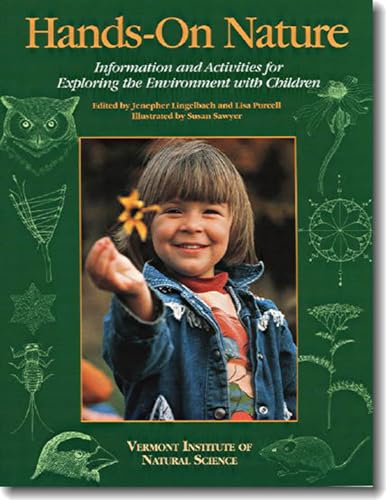
Revised and Expanded Edition This long-awaited revision of a popular book provides information and activities to assist educators and parents in exploring the local environment with children. Grouped around five themes (Adaptations, Habitats, Cycles, Designs of Nature, and Earth and Sky), fact-filled essays introduce each subject, followed by field-tested, experiential activities that engage students in learning about the natural world. With complete instructions and background information for teaching over 40 natural science units, and scientifically accurate drawings illustrating each topic, this easy-to-use, beautifully illustrated, up-to-date environmental education handbook both enables novice leaders to teach nature subjects successfully and offers creative new approaches for experienced educators.
"In my fifteen years of experience in the field, Hands-On Nature is the first book I reach for when planning a program. The book has been and continues to be a treasured resource at our nature center. From the puppet shows to the games to the observational investigations, the activities are fun and engaging for many different age levels. It is a must-have for every nature educator's book shelf!" -- Melinda Henning, Manager of Interpretive Services, Mill Creek MetroParks, Canfield, Ohio
From the reviews of the First Edition --
"The activities in Hands-On Nature give educators super ideas for teaching all about animals, plants, seasons, and other natural history subjects . . . for example, kids can run in a spider web relay, participate in a pine cone puppet show, or investigate honeybee haunts." -- NatureScope News, National Wildlife Federation
"This book has everything a teacher or environmental education group leader needs: sound and timely science, exciting, highly interesting activities; and ways to relate scientific ideas to other subjects such as language arts and fine arts. All of the activities are fun, but each of them also delivers an important message from biology and ecology. Ideas can be found here that can be used in any geographical area of our nation and with age groups from pre-schoolers to senior citizens." -- Alan J. McCormack, University of Wyoming